
The Federal Reserve meets on October 28 with its policy rate at 3.75%–4.00%, after a unanimous 25bp hike on September 16. Markets broadly expect a hold. The more interesting signal, however, came two weeks earlier and from a different desk: on October 14 the New York Fed published a purchase schedule for October 15 to November 13 with no reserve management purchases (RMPs, i.e. outright Treasury bill buying designed to keep bank reserves ample) for a third consecutive month. Only about $14.6bn of reinvestment purchases are planned.
That combination looks contradictory at first glance. The Fed spent the first half of 2026 expanding its balance sheet, and is now raising rates. In practice it reflects a deliberate separation of two dials: the policy rate sets the price of money, while the balance sheet is now managed purely to keep the quantity of reserves in the system ample. Understanding that split matters for anyone reading funding markets, bill supply or bank liquidity into year-end.
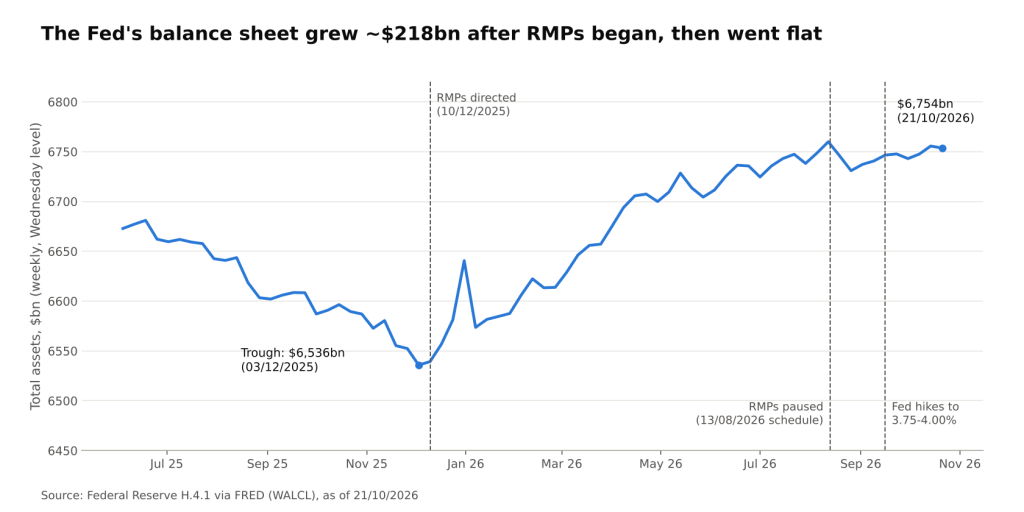
Federal Reserve total assets, weekly Wednesday level, $bn (Federal Reserve H.4.1 via FRED, WALCL @ 21/10/2026)
From Runoff to Reserve Management
On December 10, 2025, the FOMC directed the Desk to begin RMPs on December 12, starting with roughly $40bn of bills in the first monthly schedule. The New York Fed was explicit that the pace would stay elevated for a few months to pre-fund the large April increase in non-reserve liabilities, i.e. the Treasury’s tax-season cash build, and then slow sharply. Press reports put the subsequent path at about $25bn in April, about $10bn a month from May to July, and zero from the schedule published on August 13.
The H.4.1 data show the result. Total assets troughed at $6,536bn on December 3, 2025 and reached $6,754bn by October 21, 2026, an increase of roughly $218bn. Since September 16, the week of the hike, assets have moved by only about $7bn. For perspective, the balance sheet remains about $2.2tn (around 25%) below its April 2022 peak of $8,965bn.
Three features distinguish this from quantitative easing:
- Instrument. Purchases are concentrated in Treasury bills, with coupons limited to maturities of 3 years or less if needed. The Fed is not removing duration from the market.
- Objective. The stated goal is maintaining an ample level of reserves, not easing financial conditions. The September 16 implementation note authorizes bill purchases only “when appropriate” for that purpose.
- Sizing. Purchases are sized to trend growth in demand for Fed liabilities plus seasonal swings, which is why they were front-loaded and then wound down.
Reserves Pinned Near $3 Trillion
The quantity target is visible in reserve balances. In the week to October 21, reserves averaged $2,963bn. Across 2026 the weekly average has ranged between $2,895bn and $3,143bn, compared with about $2,858bn in the week of December 3, 2025, just before purchases began. That is a gain of roughly $104bn, less than half of the asset expansion, because other liabilities absorbed the rest.
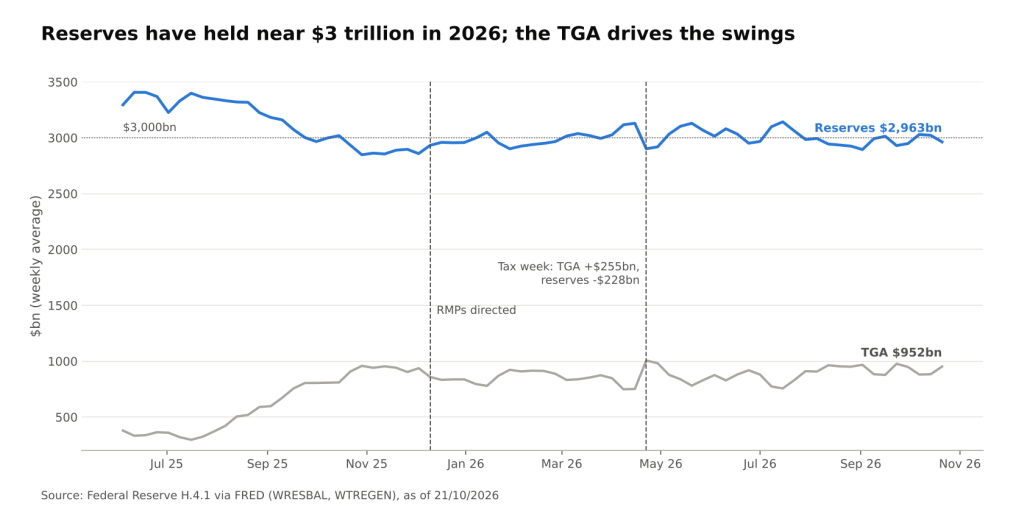
Bank reserve balances vs Treasury General Account, weekly average, $bn (Federal Reserve H.4.1 via FRED, WRESBAL and WTREGEN @ 21/10/2026)
The chart also shows why the Fed front-loaded its buying. In the week to April 22, the Treasury General Account (TGA, i.e. the Treasury’s cash account at the Fed) jumped by about $255bn while reserves fell by about $228bn. Dollar for dollar, Treasury cash drains bank reserves. Without the earlier RMPs, that tax-week drop would have started from a lower base. The TGA stood at $952bn on October 21.
Why the Desk Stepped Back
According to reporting on the October schedule, SOMA manager Roberto Perli pointed to three factors: a lower projected year-end Treasury cash balance, overnight rates consistent with reserves in the upper part of the ample range, and markets absorbing roughly $400bn of net bill issuance in July and August with only modest repo pressure. The price data are consistent with that reading. Per FRED, SOFR (the Secured Overnight Financing Rate) printed between 3.87% and 3.90% from October 16 to 22, against interest on reserve balances (IORB) of 3.90%. A repo rate at or slightly below IORB suggests banks are not scrambling for cash.
The corridor around that level is defined by three administered rates set on September 16:
- ON RRP rate at 3.75%: the floor, where money funds can park cash at the Fed.
- IORB at 3.90%: what banks earn on reserves, and the main anchor for overnight rates.
- Standing repo rate at 4.00%: the ceiling, where eligible counterparties can borrow against Treasuries.
As long as SOFR trades below IORB rather than pressing toward the 4.00% standing repo rate, the Desk has little reason to add reserves. That is why rate hikes and paused purchases are compatible: tighter policy works through the level of the corridor, not through scarcity of reserves.
Pressure Points into Year-End
The pause is not a commitment. A New York Fed spokesperson said operations are not on a preset course, and several dealers expect purchases to resume around mid-November. The variables worth monitoring are specific:
- Month-end and bank year-ends. The Federal Home Loan Bank of New York flagged October 30, a Canadian bank fiscal year-end, as a likely pressure point, alongside cash leaving repo for mortgage-bond payments.
- Dealer inventories. The same update noted dealers’ net bill holdings at a two-year high. Heavy inventories consume balance sheet and can push repo rates higher if bill supply stays heavy.
- The TGA path. A rebuild of Treasury cash drains reserves one for one. A lower-than-expected year-end balance was part of the case for pausing, so any upward revision would weaken it.
- SOFR relative to IORB. A sustained move of SOFR above 3.90% would be the clearest sign that reserves have slipped from abundant toward merely ample.
For fixed-income investors, the implication is that front-end funding conditions now depend more on the Treasury’s cash management and dealer capacity than on the Fed’s rate path. A hold on October 28 would not change the corridor, but commentary on December and on the reserve outlook may matter more for bill and repo pricing than the rate decision itself.
Conclusion
The Fed is running two independent dials. The policy rate has moved higher to address inflation, while the balance sheet, after growing about $218bn from its December 2025 trough, has been held roughly flat with reserves near $3tn. Paused RMPs are a technical judgment that reserves are sufficient, not a policy signal in either direction.
The next tests arrive quickly: the October 28 decision and press conference, the October 30 year-end pressures, and the mid-November purchase schedule. If SOFR stays at or below IORB through those dates, the case for keeping RMPs at zero strengthens. A persistent move above it would likely bring bill purchases back.
Sources: FOMC statement, Sept 16, 2026; Implementation Note, Sept 16, 2026; New York Fed operating policy, Dec 10, 2025; FRED series WALCL, WRESBAL, WTREGEN, SOFR, IORB; Newsquawk; Roic.ai; BigGo Finance; CryptoSlate (citing FHLBNY); CoinDesk.
Daniel Rivas



Leave a Reply