
Eight months into the Iran war, the headline oil price tells only part of the story. Brent has been volatile, with monthly averages ranging from the low $80s to the high $110s since March, but the price that is doing the most economic damage sits further down the barrel. On 26 October 2026, the US average retail price of diesel was $6.35 per gallon, up 70.8% on a year earlier, against a 40.7% rise for regular gasoline at $4.27, according to weekly EIA data via FRED.
That gap matters for anyone tracking inflation, credit or energy equities. Diesel moves freight, farm equipment, construction and much of industrial logistics, so it feeds into goods prices with a lag. With the Fed having raised rates last month for the first time in three years and announcing its next decision on 28 October, the question is no longer just where crude goes, but why refined products, and diesel in particular, have decoupled from it.
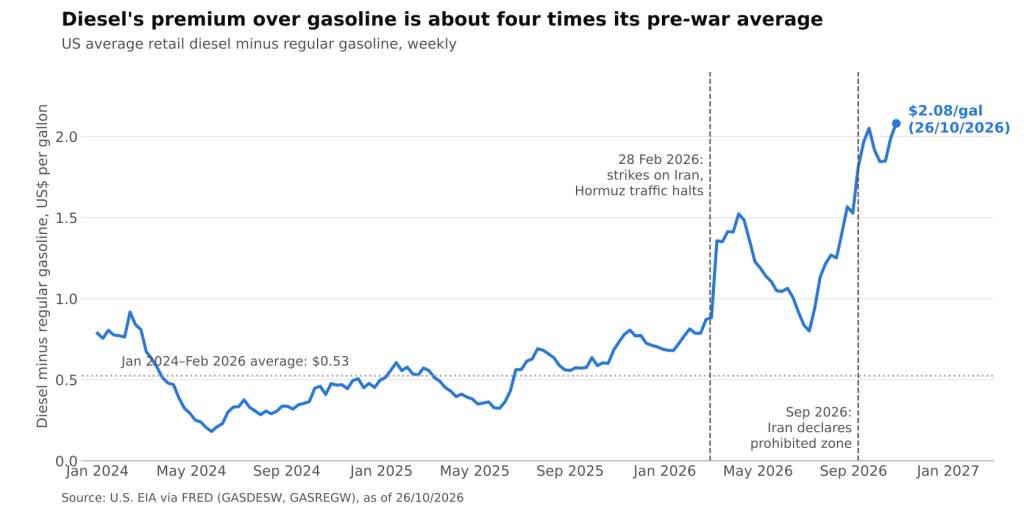
US retail diesel minus regular gasoline, weekly, US$ per gallon (EIA via FRED GASDESW, GASREGW @ 26/10/2026)
A Spread at Four Times Its Pre-War Average
The cleanest way to isolate the distillate problem is to compare the two main road fuels directly. Both share the same crude input and broadly the same retail distribution system, so the diesel-gasoline spread (i.e. diesel price minus gasoline price) strips out much of the crude move and highlights what is specific to middle distillates.
- Pre-war baseline: from January 2024 to February 2026, the spread averaged about $0.53 per gallon. In the week of 23 February 2026, just before the strikes on Iran on 28 February, it stood at $0.87.
- First shock: by early March, Strait of Hormuz traffic had collapsed and the spread jumped to $1.36 in the week of 9 March, before easing through the early summer.
- Second leg: after Iran declared a prohibited zone around the strait in early September, the spread widened again, to $2.08 on 26 October, the widest reading since at least January 2024 and roughly four times the pre-war average.
Measured as a ratio, diesel now costs about 1.49x gasoline at the pump, versus 1.30x in late February. Diesel retail prices did peak at $6.53 in the week of 21 September and have dipped slightly since, but gasoline has eased faster, so the spread has moved back above its September high.
Decomposing the Price: Crude Versus the Downstream Wedge
A second lens separates the crude cost from everything that sits between the wellhead and the pump. Converting monthly Brent from dollars per barrel to dollars per gallon (dividing by 42) and subtracting it from retail prices gives a rough downstream wedge, i.e. refining margins, distribution, retail margins and taxes. Taxes are largely fixed per gallon, so changes in the wedge mostly reflect refining and logistics.
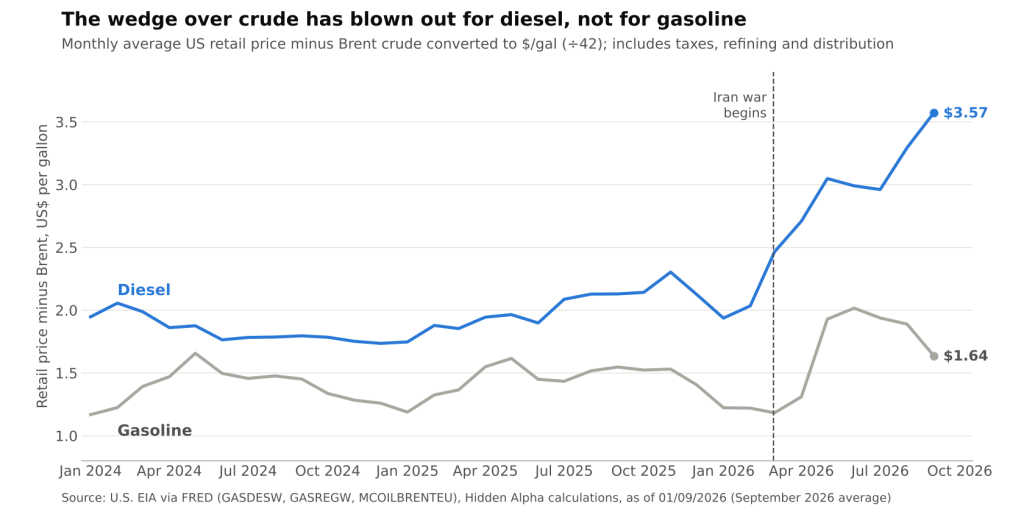
Monthly US retail diesel and gasoline prices minus Brent per gallon (EIA via FRED GASDESW, GASREGW, MCOILBRENTEU; Hidden Alpha calculations @ 01/09/2026)
Comparing September 2026 with September 2025, Brent averaged $114.16 per barrel against $67.99, adding about $1.10 per gallon to crude costs. The two fuels then diverge sharply:
- Gasoline: retail rose by about $1.19 per gallon. The wedge over Brent moved only from $1.55 to $1.64, so crude explains almost all of the increase, and the wedge remains near its 2024–2025 range.
- Diesel: retail rose by about $2.54 per gallon. The wedge widened from $2.13 to $3.57, so roughly 57% of the increase came from the downstream side rather than from crude.
In other words, the gasoline price is behaving like a crude-pass-through product, while diesel is pricing a refining and logistics shortage. That distinction is central for forecasting: a crude-led shock can reverse quickly if Brent falls, but a product-led shock depends on inventories and refinery capacity, which adjust far more slowly.
Why Distillates Are Tighter Than Gasoline
Several mechanisms explain why the squeeze is concentrated in the middle of the barrel:
- Lost Gulf supply: industry analysis from RBN Energy points to damage to Middle Eastern refineries and disrupted product flows around Hormuz. That removes refined barrels from the market, not just crude, and the loss shows up first in the tightest product pool.
- Thin inventories: the EIA’s October Short-Term Energy Outlook puts US East Coast distillate stocks 32% below their 2021–2025 seasonal average in September and expects them to stay 20–30% below average through the winter.
- Structural capacity limits: global refining capacity was already tight after pandemic-era closures, and US refiners, per RBN, have been running hard and exporting record volumes. When the marginal diesel barrel is exported to replace lost Gulf supply, US prices are set by global scarcity.
- Seasonality: heating oil demand, which competes for the same distillate pool, rises into the Northern Hemisphere winter, adding pressure exactly when inventories are lowest.
Crude, by contrast, has partial offsets: the EIA estimates Middle East crude shut-ins at 4.8 million b/d in September, down from a 10.9 million b/d peak in May, and strategic stock releases have added barrels. Those measures ease crude, but they do not create refinery capacity.
Implications for Inflation, Credit and Corporate Margins
- Inflation persistence: diesel is an input cost for freight and goods distribution, so a durable diesel premium can keep core goods inflation elevated even if headline energy prices stabilize. That complicates the Fed’s task, since the tightening is aimed at a supply shock that monetary policy cannot fix directly.
- Sector dispersion: trucking, airlines (via jet fuel, a sister distillate), agriculture and chemicals face margin pressure, with pass-through ability varying widely. Fuel surcharges lag, and smaller carriers with weaker balance sheets typically absorb more of the hit, which is relevant for leveraged credit.
- Refiners as relative beneficiaries: a wide distillate wedge typically supports refining margins for complex, distillate-heavy refiners, although utilization constraints and maintenance cap how much incremental volume they can capture.
- Forecast risk: models that map crude to CPI through gasoline alone will understate the cost shock. The diesel wedge is the variable to monitor separately.
What Would Narrow the Spread
The EIA expects retail diesel to stay above $6 per gallon in October and then decline gradually, while remaining above $4 through 2027. Its forecast also has Brent averaging about $105 per barrel in 4Q26 and about $84 in 2027. A narrowing of the diesel-gasoline spread would likely require some combination of reopening of Gulf product exports, a rebuild of distillate inventories, and softer industrial demand. A diplomatic breakthrough on Hormuz would help crude first; the distillate wedge would probably lag, given how depleted inventories are.
Conclusion
The oil shock of 2026 is increasingly a diesel shock. Since September 2025, gasoline’s rise has been almost entirely a crude story, while more than half of diesel’s increase has come from the downstream wedge. At $2.08 per gallon, the diesel-gasoline spread signals a shortage of refined middle distillates that crude-focused analysis tends to miss.
Going forward, the key indicators are weekly EIA distillate inventories, the diesel-gasoline spread itself, the Fed’s 28 October statement on energy-driven inflation, and any change in tanker and product flows through Hormuz. A falling Brent price without a narrowing diesel wedge would mean the cost pressure on freight and goods has not yet eased.
Sources: EIA via FRED, US Diesel Sales Price (GASDESW); EIA via FRED, US Regular Gas Price (GASREGW); EIA via FRED, Brent Crude (MCOILBRENTEU); EIA Short-Term Energy Outlook, October 2026; RBN Energy; 2026 Strait of Hormuz crisis timeline; AP via Transport Topics.
Daniel Panizo, CFA, FMVA


Leave a Reply