
On 26 October, Bank of America, Citi, Morgan Stanley and Blackstone lined up a $63bn package to finance Broadcom AI chips and networking gear for Anthropic. The money does not go to Broadcom or Anthropic directly. A newly formed special purpose vehicle (SPV), i.e. a standalone company whose only business is owning the equipment, buys the hardware and leases it to Anthropic. The lease payments service the debt, and Broadcom provides residual value support, i.e. a backstop on what the chips are worth if the lease does not run its course.
The deal matters less for its headline size than for what it says about where AI debt is going. For most of 2026 the AI buildout was funded through plain hyperscaler bonds that sit on balance sheets and in index weights. Increasingly, it is being funded through structures that sit off them. That shift has a price, and the broad investment-grade market is only starting to show it. The ICE BofA US Corporate Index option-adjusted spread (OAS) stood at 88bp on 27/10/2026, up 14bp from its 74bp month-end low in May.
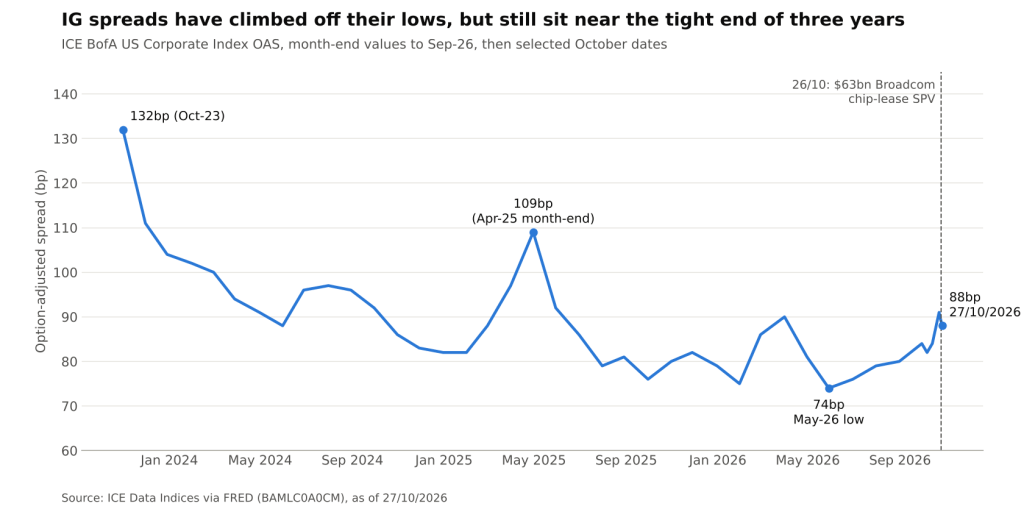
ICE BofA US Corporate Index option-adjusted spread, month-end values with selected October 2026 dates (ICE Data Indices via FRED, BAMLC0A0CM @ 27/10/2026)
Anatomy of the Broadcom Chip-Lease Structure
Public reporting gives a fairly clear picture of the capital stack, although the tranche figures differ slightly by outlet:
- Senior secured debt: banks are lending about $42bn, according to Bloomberg, with a first claim on the SPV’s assets and Broadcom’s residual value support behind it. Reuters, citing two sources, puts first-lien debt at about $43.5bn, or roughly 69% of the package.
- Junior capital: Blackstone is committing $9bn on the subordinated side. That leaves about $12bn of the total that has not been publicly broken out.
- Takeout plan: the arrangers plan to sell up to about $21bn of high-grade bonds with a tenor of around five years, as early as the first quarter of 2027. That would refinance as much as half of the bank-lent portion, depending on market conditions.
- Timing: equipment deliveries are expected to begin in 2027, so the debt is being raised ahead of the cash flows it will finance.
This is Broadcom’s second structure of its kind this year. An earlier $35bn financing with Apollo and Blackstone expanded Anthropic’s compute capacity, and Broadcom backstopped up to $29bn of it, according to a company filing. Reporting at the time noted that the backstop helped the senior tranches reach investment-grade ratings. In practice, this is vendor financing at a scale usually seen in aircraft leasing rather than semiconductors. The credit risk sits with the lessee and the collateral value, and the vendor’s balance sheet sits behind both.
Why the Market Is Moving Off Balance Sheet
The public bond market has been absorbing hyperscaler supply, but less and less easily. J.P. Morgan Asset Management (JPMAM) counted $219bn of hyperscaler investment-grade issuance in 2026 by 20 August, including $62bn equivalent in non-dollar currencies. It expects the group’s share of US dollar IG issuance to reach 9% this year, up from 2% in 2022–2024. Three signals show that demand is tiring:
- Concessions: a Reuters analysis of LSEG data found that the median new-issue concession on hyperscaler deals, i.e. the extra yield paid over existing bonds to clear a new one, rose to 12bp in 2026 from 2.25bp in 2025.
- Order books: Apollo estimated that cover ratios on hyperscaler bond sales fell from nearly 5x in February to below 2x in July.
- Relative spreads: JPMAM found that hyperscaler spreads had widened about 30bp year to date, against about 2bp for the dollar IG index.
Index concentration adds a structural limit. JPMAM put the hyperscalers at about 3.5% of the dollar IG index at the start of 2026, and estimates that their combined weight could approach 10% by 2030. For benchmarked IG managers, issuer and sector limits bind long before a credit becomes risky. SPV and lease structures get around that constraint: the debt is not issued by the hyperscaler, and much of it never enters the index. JPMAM estimates that disclosed data-center lease obligations already total about $1.4tn, of which about $1.1tn is off balance sheet.
The Spread Ladder: Pricing Each Step Away From the Parent
Moving debt off the balance sheet does not remove its cost; it reprices it. JPMAM’s estimates trace a clear ladder, in which each step further from a parent’s unsecured balance sheet costs more spread.
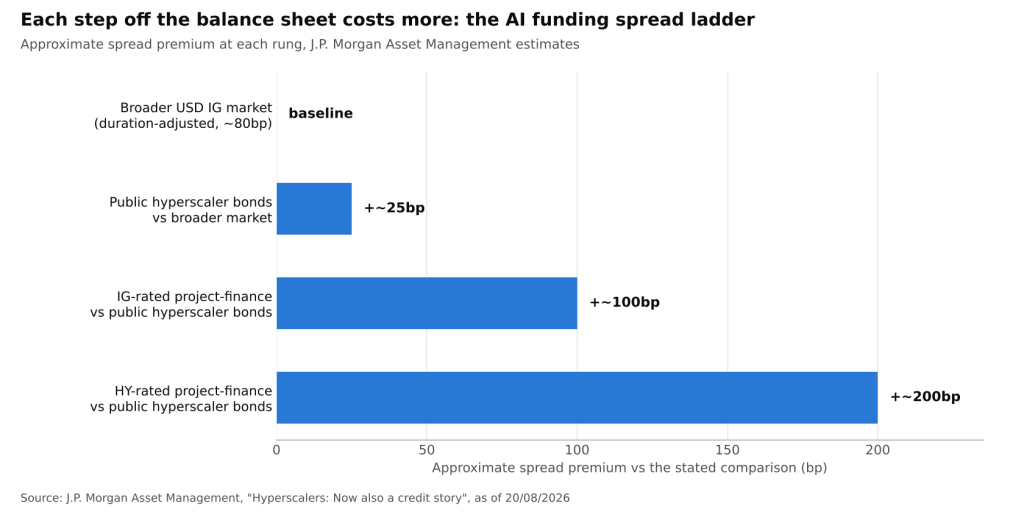
Approximate spread premium at each rung of AI funding structures (J.P. Morgan Asset Management @ 20/08/2026)
- Rung one, public hyperscaler bonds: about 105bp duration-adjusted, against about 80bp for the broader market. That is a premium of roughly 25bp for issuers with some of the strongest balance sheets in the index.
- Rung two, IG-rated project finance: about 100bp over equivalent public hyperscaler bonds. Investors are paid for complexity, illiquidity and collateral risk on rapidly depreciating hardware.
- Rung three, HY-rated project finance: about 200bp over public hyperscaler paper, where the backstop is thinner or the lessee is weaker.
The Broadcom package sits on the upper rungs of this ladder, but with a twist. Residual value support from a highly rated vendor is designed to pull the senior tranche toward rung one. How tight the planned $21bn bond prices next year will show how much credit investors are willing to give a vendor backstop, as opposed to the lessee’s own credit and the collateral’s resale value.
What It Means for IG Spreads and Credit Analysis
The broad index has so far absorbed the AI supply wave with only modest damage. At 88bp, ICE IG OAS is 9bp wider than at the end of 2025 and still 44bp tighter than in October 2023. October was choppy: the spread dipped to 82bp on 7 October, then widened to 91bp on 23 October before easing. Three implications stand out:
- Leverage is understated by headline metrics: reported debt-to-EBITDA misses SPV leases and purchase commitments. JPMAM estimates the hyperscalers could add about $1.5tn of debt before lease-adjusted leverage reached the IG industrials average. That is ample headroom, but it is only visible if leases are capitalized, much as rating agencies already adjust for operating leases.
- Supply is migrating, not disappearing: JPMAM projects about $2.1tn of IG bond funding and about $0.7tn from high-yield bonds, leveraged loans and securitization for the AI buildout. Some of that second bucket is likely to resemble the Broadcom structure, spreading AI exposure into private credit, ABS and bank balance sheets.
- Concentration risk is moving to vendors and lessees: Moody’s described Broadcom as one of the strongest large technology companies, but warned that risk would rise if many such transactions were done in a short period. A vendor that backstops several chip SPVs takes on a contingent liability that looks a lot like leverage.
Conclusion
The $63bn Broadcom package marks a shift in how AI capex is financed, from hyperscaler balance sheets toward lease-backed SPVs, vendor backstops and private capital. The market is pricing that shift through a spread ladder rather than through the headline IG index, which remains near the tight end of its three-year range at 88bp. For credit analysts, the more useful numbers are lease-adjusted leverage and contingent vendor support, not reported debt.
Three things are worth watching: the pricing of the up to $21bn IG takeout bond in early 2027, the size of new-issue concessions on the next hyperscaler deals, and whether ICE IG OAS can hold below its October high of 91bp as structured AI supply builds.
Sources: ICE BofA US Corporate Index OAS via FRED; Bloomberg, Banks Eye $21 Billion of Bonds for Broadcom Chip-Financing Deal; Reuters, Wall Street banks, Blackstone line up $63 billion; J.P. Morgan Asset Management, Hyperscalers: Now also a credit story; Reuters, Hyperscaler debt binge pushes yields up.
Daniel Panizo, CFA, FMVA


Leave a Reply