
Private credit is usually described as lending that happens outside the banking system. The Federal Reserve’s latest H.8 data, released on 23/10/2026, tells a more nuanced story: US commercial banks held $2,105.8bn of loans to nondepository financial institutions (NDFIs, i.e. nonbank lenders, funds, finance companies and similar intermediaries) in the week to 14/10/2026. That is up $345.7bn, or 19.6%, from $1,760.1bn a year earlier.
The timing matters. In the latest quarter, a bellwether listed business development company (BDC, i.e. a closed-end vehicle that holds direct-lending loans) reported higher non-accruals and a lower net asset value, while nontraded BDCs still faced redemption queues larger than what managers were willing to pay out. The question for credit analysts is no longer whether banks compete with private credit, but how much of private credit’s risk now sits one layer up, on bank balance sheets.
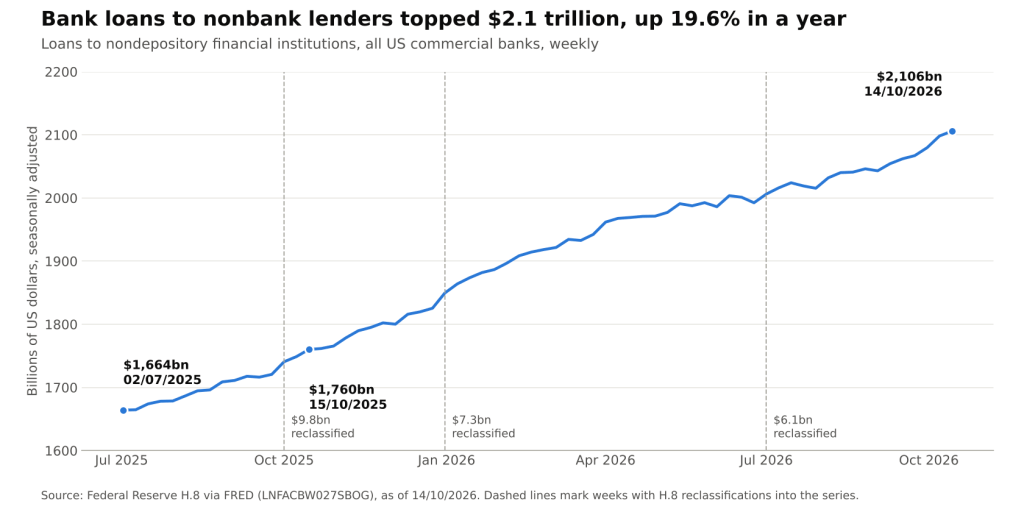
Loans to nondepository financial institutions, all US commercial banks, weekly, seasonally adjusted (Federal Reserve H.8 via FRED, LNFACBW027SBOG @ 14/10/2026)
Reading the Series Through the Reclassifications
Reading the NDFI series requires care, because part of its growth is definitional. Following clarified Call Report instructions, the H.8 notes record a series of reclassifications into the NDFI line. The largest came in the week of 02/07/2025, when domestic banks moved $41.7bn and foreign-related institutions $28.1bn into the category. Smaller shifts followed on 31/12/2025 ($7.3bn) and 01/07/2026 ($6.1bn).
Stripping those two later reclassifications out of the latest twelve months still leaves growth of roughly $332.3bn, or about 18.9%. The momentum has not faded either: the line added $62.8bn in the six weeks to 14/10/2026, a window that excludes the reclassifications listed above. For scale, the NDFI book now equals about 70% of the $2,992.6bn of commercial and industrial (C&I) loans banks reported for the same week.
Three caveats keep the series honest:
- It is broad. The NDFI bucket covers mortgage lenders, consumer finance companies, private equity funds and other intermediaries, not only private credit vehicles.
- It is not comparable across breaks. Long-run growth rates spanning the 2025 reclassifications overstate organic lending.
- It measures exposure, not loss. Lending to funds typically ranks senior to the fund’s own equity, so the balance is not a proxy for credit losses.
How Banks Sit Inside the Private Credit Stack
The mechanics explain why banks are comfortable growing this book. Rather than originating a unitranche loan to a mid-market borrower, a bank lends to the fund or BDC that holds a diversified pool of such loans. The bank’s claim sits senior to the fund’s equity, which absorbs first losses.
- Subscription lines lend against investors’ uncalled capital commitments, bridging capital calls.
- Asset-based facilities lend against the loan portfolio itself, with advance rates and borrowing-base tests.
- Unsecured notes and revolvers to listed BDCs rank alongside other corporate debt of the vehicle.
Ares Capital, a bellwether listed BDC, illustrates the cushion. Its Q3 2026 release (27/10/2026) showed $15.5bn of principal debt against $13,946m of stockholders’ equity at 30/09/2026, a debt-to-equity ratio of 1.11x. Lenders to such a vehicle are protected by roughly a dollar of equity for every dollar of debt, before any recovery on the underlying loans.
Stress Is Visible, but Still in the Equity Layer
The same release shows where the pressure is being absorbed. Ares Capital’s loans on non-accrual status (i.e. no longer paying interest as scheduled) rose to 2.4% of investments at amortized cost at 30/09/2026, from 1.8% at 31/12/2025, a 60bp increase. Net asset value per share fell 3.2% over the same period, from $19.94 to $19.31, and core EPS of $0.46 fell short of the $0.48 quarterly dividend.
In other words, credit losses are eroding BDC equity and payout coverage, which is exactly what the capital structure is designed to do. Bank lenders one layer up remain covered, but the cushion is shrinking in dollar terms: Ares Capital’s stockholders’ equity fell from $14,318m at 31/12/2025 to $13,946m.
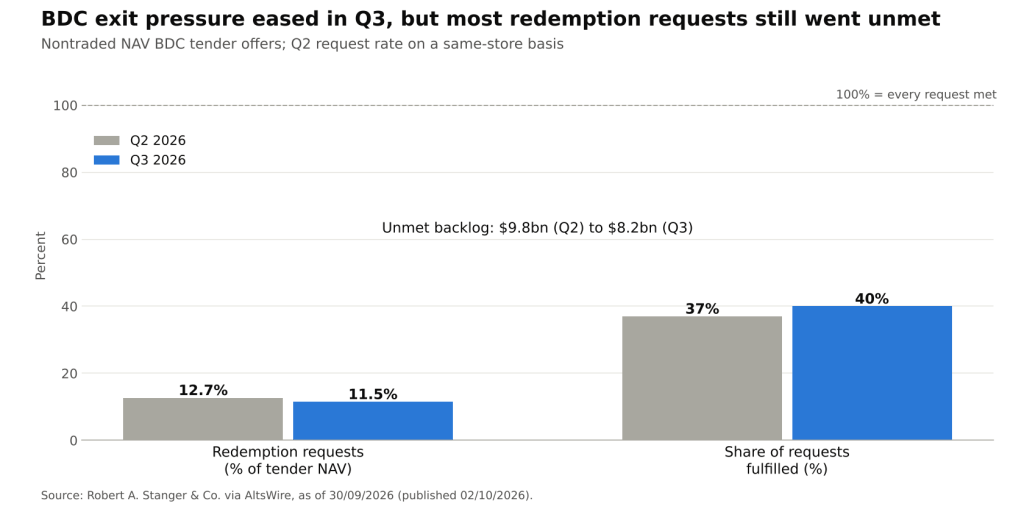
Nontraded NAV BDC tender offers: redemption requests as a share of tender NAV and share of requests fulfilled, Q2 vs Q3 2026 (Robert A. Stanger & Co. via AltsWire @ 30/09/2026)
The nontraded side adds a liquidity dimension. According to Robert A. Stanger & Co., NAV BDCs received $13.8bn of redemption requests in Q3 2026, equal to 11.5% of estimated tender-offer NAV, down from 12.7% in Q2 on a same-store basis. Managers met about 40% of requests, up from 37%, and the unmet backlog shrank from $9.8bn to $8.2bn. Blackstone’s BCRED alone received about $4.3bn of Q3 repurchase requests while holding payouts to its 5% quarterly cap.
Why Bank Leverage and Fund Liquidity Interact
Redemption gates protect fund lenders in the short run because they stop forced asset sales. The risk is subtler: a vehicle facing persistent outflows and rising non-accruals may lean harder on bank facilities to fund tenders, new commitments or distributions. That is where the two data sets connect.
- Borrowing-base tests. Asset-based facilities typically reduce availability as loans move to non-accrual or are marked down, tightening liquidity just as it is needed.
- Concentration. Exposure to many funds that hold overlapping sponsor-backed borrowers is less diversified than the number of counterparties suggests.
- Rate sensitivity. With 70% of Ares Capital’s portfolio at fair value in floating-rate securities and a 10.6% weighted average yield on debt at amortized cost, higher base rates lift fund income but also strain borrowers’ interest coverage.
None of this implies imminent bank losses. Senior lending to diversified funds is protected by the equity beneath it. It does mean that the headline separation between “bank credit” and “private credit” understates how closely the two are linked.
Conclusion
Bank loans to nonbank lenders have grown to roughly $2.1tn, rising close to 19% in a year even after adjusting for reclassifications, while the private credit vehicles they help finance are absorbing higher non-accruals, NAV declines and persistent redemption queues. So far the losses sit in fund equity, which is where the structure is meant to put them.
The next signals to watch are the H.8 NDFI line in the coming weekly releases, Q3 10-Q disclosures on BDC credit facility usage and borrowing-base headroom, and Q4 tender results for nontraded BDCs. A combination of rising facility draws and a re-widening redemption backlog would mark the point at which private credit stress starts to travel up the capital stack.
Sources: FRED, Loans to Nondepository Financial Institutions (LNFACBW027SBOG); FRED, Commercial and Industrial Loans (TOTCI); Federal Reserve, H.8 release notes; Ares Capital, Q3 2026 results (SEC 8-K); AltsWire, Nontraded BDC Redemption Requests Decrease in Q3 (Stanger data).
Daniel Panizo, CFA, FMVA


Leave a Reply