
Two of the largest US electric utilities used their third-quarter results to raise the stakes on the data-center build-out. On October 28, American Electric Power (AEP) unveiled a $100 billion five-year capital plan for 2027–2031 and said its rate base, i.e. the asset value on which regulators let it earn a return, should reach $162 billion by 2031. A day earlier, CenterPoint Energy lifted its 10-year plan from $66.7 billion to $70.7 billion.
The headline numbers invite a simple reading: more assets, more regulated earnings. The guidance itself tells a more nuanced story. Both companies project their rate base to compound materially faster than their earnings per share. That gap, roughly 3 percentage points a year at AEP and around 5–6 points at CenterPoint on midpoint assumptions, is the price of financing the build-out, and it is the most useful number for anyone analyzing the sector.
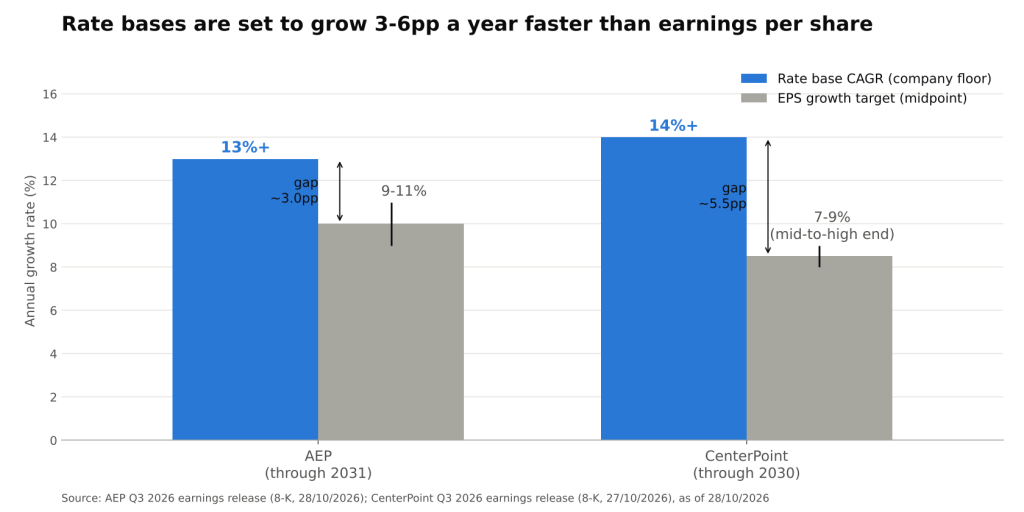
Rate base growth versus EPS growth targets, AEP and CenterPoint (Company Q3 2026 earnings releases @ 28/10/2026)
The Plans in Numbers
AEP’s plan is the larger and more explicit of the two. Roughly $95 billion of the $100 billion is allocated across three buckets:
- Transmission: about $37 billion, with transmission rate base expected to approach $70 billion by 2031.
- Generation: $36 billion, i.e. new generating capacity.
- Distribution: about $22 billion, the local wires network.
Management guides to a 13%-plus rate base compound annual growth rate (CAGR) through 2031, but to operating EPS growth of 9%–11% a year from 2027. Near-term delivery is strong: third-quarter operating EPS rose to $2.23 from $1.80, a 24% increase, and the company expects 2026 to land at or above the top of its $6.25–$6.55 range. New guidance of $6.75–$7.05 for 2027 and $7.40–$7.70 for 2028 is consistent with the 9%–11% path.
CenterPoint shows the same shape. Its plan implies rate base growth of more than 14% a year through 2030, while EPS growth is guided to the mid-to-high end of a 7%–9% range. Third-quarter non-GAAP EPS was $0.53 versus $0.50, and 2027 guidance of $2.07–$2.09 implies roughly 9% growth over the raised 2026 range.
Why Rate Base Outruns EPS
In a regulated utility, earnings are approximately the allowed return on equity multiplied by the equity-financed share of rate base. If every dollar of new rate base were funded with retained earnings and debt at the regulated capital structure, EPS would grow roughly in line with the asset base. It does not, for three reasons:
- Equity dilution: capex well above internally generated cash forces utilities to issue shares, often via at-the-market programs or forward sales. Earnings grow, but they are spread over a larger share count.
- Financing costs: parent-level debt carries interest but earns no regulated return. CenterPoint explicitly cited a $0.04 per-share headwind in the quarter from new debt issuance and equity dilution, against a $0.09 contribution from growth and rate recovery.
- Regulatory lag: assets under construction do not always earn a full return until rates are reset, so earnings trail spending during an acceleration.
Compounding makes the gap meaningful. At 13% a year, AEP’s rate base grows about 1.84x over five years; at 10%, EPS grows about 1.61x. The difference is effectively value that accrues to the new capital providers rather than to existing shareholders on a per-share basis.
Demand Is Real, and Concentrated
The capex is increasingly backed by contracts. AEP signed 15 GW of new load commitments in the third quarter alone and expects incremental contracted load to reach 84 GW by 2031, counting only projects backed by executed service agreements or letters of agreement. Volumes already reflect it.
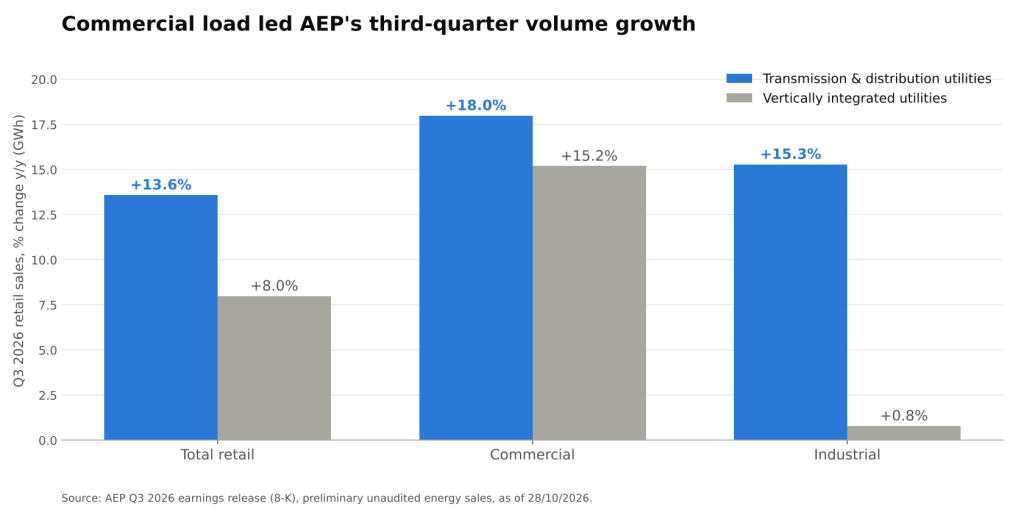
AEP third-quarter 2026 retail sales growth by customer class, year over year (AEP Q3 2026 earnings release @ 28/10/2026)
Retail sales in AEP’s transmission and distribution utilities rose 13.6% year over year in the quarter, led by commercial at 18.0%, the customer class where large data-center loads are typically booked. In the vertically integrated utilities, commercial sales grew 15.2% while industrial grew just 0.8%. For the first nine months, transmission and distribution retail sales were up 12.4%.
Contract structure matters for credit quality. AEP says take-or-pay agreements in its vertically integrated states provide up to $21 billion of fixed-cost offsets for residential customers, up from $16 billion. That mechanism, i.e. large customers paying for capacity whether or not they use it, shifts stranded-asset risk away from households and supports regulatory goodwill, which in turn supports timely cost recovery.
The Cost-of-Capital Squeeze
The financing question is sharper because borrowing costs are far from cheap. Moody’s seasoned Baa corporate bond yield stood at 6.47% as of 29/10/2026. Utilities pass prudently incurred debt costs to customers over time, but higher rates raise customer bills, and affordability is the binding constraint on how much capex regulators will approve. Both companies emphasized customer savings and offsets in their releases, a signal of how central that negotiation has become.
For analysts, the implications are concrete:
- Model share count explicitly: rate base growth alone overstates EPS growth in an equity-funded build-out; the dilution assumption drives the per-share outcome.
- Watch funding mix: asset sales, such as CenterPoint’s Ohio gas utility divestiture completed on October 1, tax-credit sales and securitizations reduce the need for common equity and narrow the gap.
- Track credit metrics: funds from operations to debt, i.e. cash flow coverage of leverage, is where rating agencies will test whether debt is carrying too much of the load.
Conclusion
The latest utility capital plans confirm that data-center demand is translating into contracted load and rapidly rising sales volumes. But the guidance also quantifies the cost: rate bases are set to compound several points a year faster than EPS, because a growing share of each new dollar of assets is financed with new equity and parent-level debt.
The next signals to watch are equity issuance disclosures in fourth-quarter results, the pace at which contracted gigawatts convert into energized load, and regulatory outcomes on affordability. A narrowing of the rate base–EPS gap would indicate cheaper or more internally funded growth; a widening one would suggest the build-out is costing shareholders more on a per-share basis.
Sources: AEP Q3 2026 earnings release (Form 8-K); CenterPoint Energy Q3 2026 earnings release (Form 8-K); FRED, Moody’s Seasoned Baa Corporate Bond Yield (DBAA).
Daniel Panizo, CFA, FMVA


Leave a Reply