
On Monday, Nov 2, the US Treasury trimmed its October–December borrowing estimate to $618 billion, $10 billion below its August projection, assuming it ends December with $850 billion in cash. The headline cut drew attention ahead of Wednesday’s refunding announcement, but the more consequential number sits one quarter further out: Treasury plans to borrow $800 billion in January–March and lift its cash balance to $1 trillion by the end of March.
That cash target matters because of where the money is kept. The Treasury General Account (TGA), i.e. the government’s checking account at the Federal Reserve, is a liability of the Fed that competes directly with bank reserves. When the TGA rises, reserves fall, unless the Fed adds assets to offset it. With the Fed’s bill purchases for reserve management paused for a third straight month, the Treasury’s cash plan has become the dominant short-run driver of reserve supply.
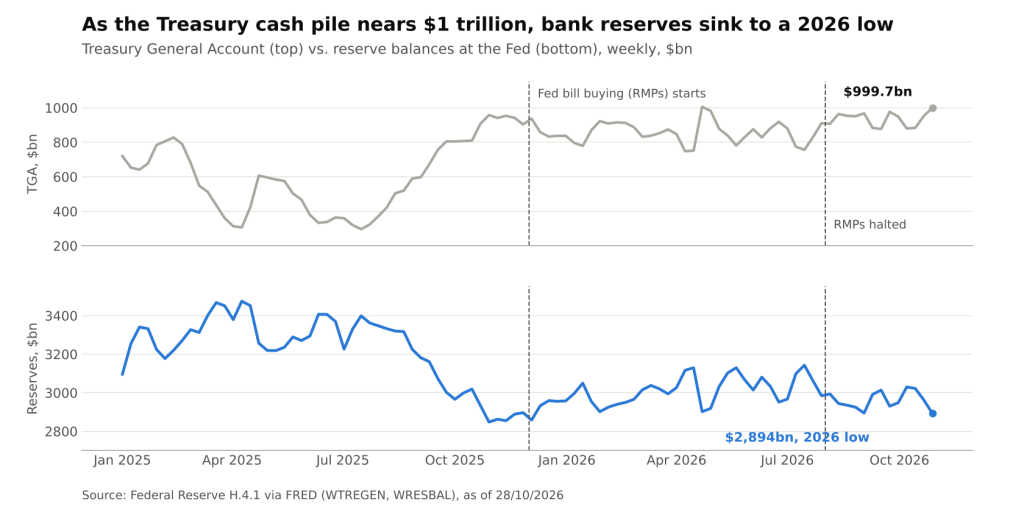
Treasury General Account vs. reserve balances at the Fed, weekly, $bn (Federal Reserve H.4.1 via FRED, WTREGEN and WRESBAL @ 28/10/2026)
A Trillion-Dollar Account, a 2026 Low in Reserves
The latest Fed balance sheet data show the TGA at $999.7 billion in the week to Oct 28, up $119.5 billion in three weeks. Over the same stretch, reserve balances fell $135.9 billion, from $3,029.7 billion to $2,893.8 billion, their lowest weekly reading of 2026. Reserves are now only $45.7 billion above the $2,848.0 billion level of late October 2025, the trough that preceded the start of the Fed’s reserve management bill purchases in December.
The contrast with last year is instructive. In July 2025, the TGA bottomed at $296.2 billion. Since then, the account has been rebuilt and kept high: its 2026 weekly average is roughly $880 billion, against about $624 billion in 2025. A structurally larger cash buffer is prudent cash management for the Treasury, but it is a permanent claim on the Fed’s balance sheet that reserves would otherwise occupy.
Dollar for Dollar: The Plumbing in One Chart
Regressing weekly changes in reserves on weekly changes in the TGA over the 43 weeks of 2026 produces a slope of -1.00 and a correlation of -0.97. In plain terms, almost every dollar that has flowed into the Treasury’s account has come out of bank reserves. Over the longer window since January 2025, the relationship is looser (slope -0.85, correlation -0.80), consistent with other Fed liabilities absorbing part of the swings earlier in the period.
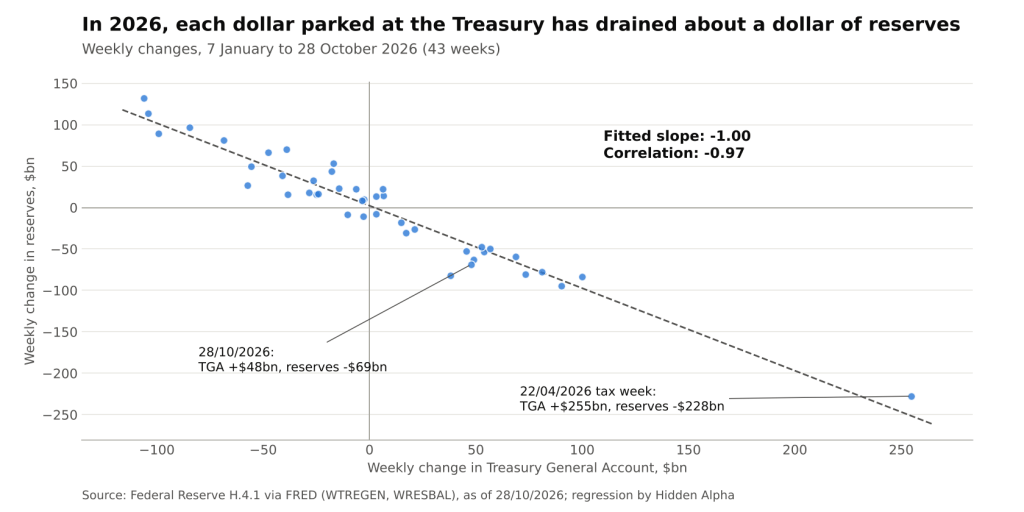
Weekly change in TGA vs. weekly change in reserves, Jan–Oct 2026, $bn (Federal Reserve H.4.1 via FRED, WTREGEN and WRESBAL @ 28/10/2026)
The April tax week is the clearest illustration: in the week to Apr 22, the TGA jumped $254.6 billion and reserves dropped $227.8 billion. The near one-for-one pass-through means the TGA path in Treasury’s financing estimates can be read, to a first approximation, as a reserve forecast with the sign flipped.
Reading the Treasury’s Cash Path as a Reserve Forecast
Translating Treasury’s assumptions into reserve pressure gives three distinct phases:
- Q3 2026 (done): Treasury borrowed $742 billion and ended September with $984 billion in cash, close to its August projection of $739 billion in borrowing.
- Q4 2026 (a tailwind): the $850 billion year-end target is $134 billion below the end-September balance and roughly $150 billion below the late-October weekly level. If the 2026 pass-through holds, the drawdown would return a similar amount to reserves into year-end, a seasonally sensitive period for funding markets.
- Q1 2027 (a headwind): rebuilding the account to $1 trillion by end-March implies a $150 billion drain relative to the December target, with the April tax date, which produced the largest weekly TGA inflow in the 2025–26 data, arriving immediately after.
Two caveats apply. Quarter-end targets are point estimates that Treasury revises every quarter, and the weekly TGA can swing by more than $100 billion within a month around tax and settlement dates. The direction of travel, however, is clear: modest relief into December, then renewed drain through the first quarter.
Where the Fed Fits In
The Fed began buying roughly $40 billion of bills a month in December 2025 to rebuild reserves, then slowed purchases to $25 billion in April and $10 billion in May before halting them in August. In mid-October, the New York Fed extended the pause to mid-November, while still reinvesting about $14.6 billion of mortgage-backed securities paydowns into bills, a swap of assets that does not add reserves.
The Oct 28 FOMC implementation note kept the federal funds target range at 3.75%–4.00%, interest on reserves at 3.90%, the overnight reverse repo rate at 3.75% and the standing repo facility at 4.00%. It also kept the directive to buy bills “when appropriate” to maintain ample reserves. Since June, the Fed has stated explicitly that temporary pauses can occur when money market conditions warrant, which makes the program reactive rather than scheduled.
The implications follow from the arithmetic:
- The pause is cheap in Q4: if the TGA drifts toward $850 billion, reserves should recover without Fed purchases, giving the Desk room to keep the pause running into year-end.
- The test comes in Q1: a $150 billion TGA rebuild with no offsetting purchases would push reserves back toward, or below, the 2026 low, unless other liabilities shrink.
- Repo is the signal: the gap between secured funding rates and interest on reserves, and usage of the 4.00% standing repo facility, is the market’s real-time read on whether reserves are still “ample.”
- Issuance mix matters too: a cash rebuild funded through bills draws heavily on money-fund cash, while coupon-heavy funding tends to land more on bank and dealer balance sheets.
Conclusion
The Treasury’s cash balance has become the swing factor for US bank reserves. In 2026, weekly TGA moves have passed through to reserves almost one-for-one, and with the Fed’s reserve management purchases on hold, the financing estimates now double as a reserve outlook: a roughly $150 billion release into December, followed by a similar-sized drain to reach a $1 trillion cash target by end-March.
What to watch next: Wednesday’s refunding statement for changes in the bill share and coupon sizes, the mid-November New York Fed purchase schedule for any restart of reserve management purchases, and weekly H.4.1 data to see whether reserves stabilize above the $2.89 trillion low as the TGA draws down.
Sources: FRED, Treasury General Account (WTREGEN); FRED, Reserve Balances with Federal Reserve Banks (WRESBAL); Federal Reserve, Implementation Note, Oct 28, 2026; Reuters via Kitco, Treasury cuts fourth-quarter borrowing estimate; Bloomberg via The Star, Fed extends pause on reserve management purchases; Bloomingbit, New York Fed extends pause for third month.
Daniel Panizo, CFA, FMVA



Leave a Reply