
The energy shock that began when fighting broke out around the Strait of Hormuz in late February has repriced natural gas almost everywhere except the place that now ships the most of it. IMF benchmark data on FRED, updated on October 22, show the EU gas price averaging $25.49/MMBtu in September 2026 and Asian LNG $26.64. The US Henry Hub price averaged $2.95. Reuters reported that the European TTF and Asian JKM benchmarks both averaged about $28 in October, while Henry Hub spot printed $2.76 on October 27.
That gap is the core puzzle. US LNG exports reached their second-highest monthly level on record in October, and the US is the marginal supplier to a market that lost Qatari volumes. In a textbook arbitrage, record exports into a $28 market should pull the home price up. They have not. The reason is a physical cap on the arbitrage, and it decides who earns the spread and when it eventually reaches US prices.
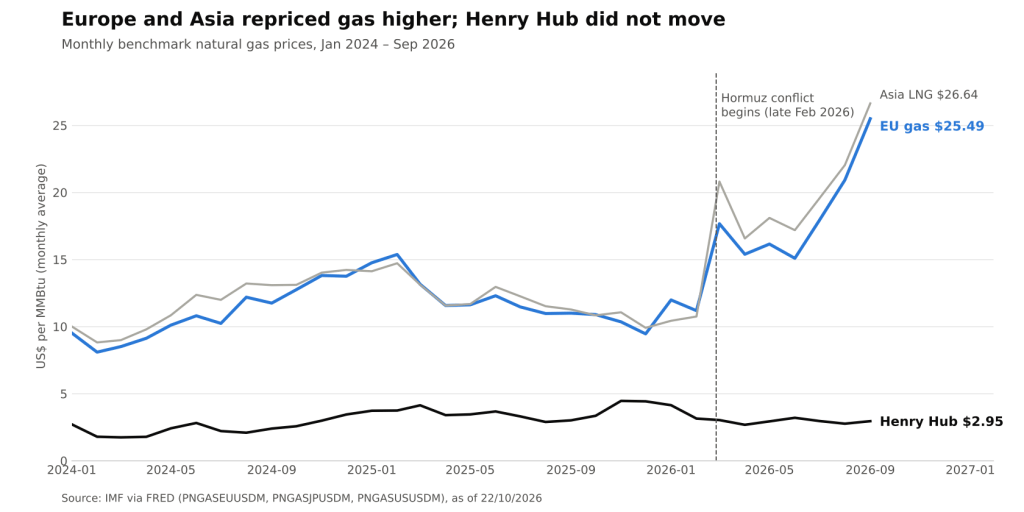
Monthly EU gas, Asia LNG and US Henry Hub benchmark prices, US$/MMBtu (IMF via FRED @ 22/10/2026)
The Spread in Numbers
Between February and September 2026, the EU price rose 127.8% and the Asian LNG price 147.7%. Henry Hub fell 6.2% over the same months. The transatlantic spread, i.e. the EU price minus Henry Hub, widened from $8.04 in February to $22.54 in September, when EU gas cost 8.6x the US benchmark. Before the conflict, the widest monthly spread since January 2024 was $11.63, in February 2025. September’s reading is almost double that.
The driver is lost supply. Before the fighting, about 20% of global seaborne LNG trade passed through Hormuz, and QatarEnergy has extended force majeure on cargoes to Italy’s Edison through early December. Rystad Energy estimates that the conflict will add at least $39 billion to global LNG import costs in 2026, even though import volumes will be 60.7 Mt lower than expected before the conflict. Europe and Asia are paying more for less gas, and the US has not been able to make up the difference.
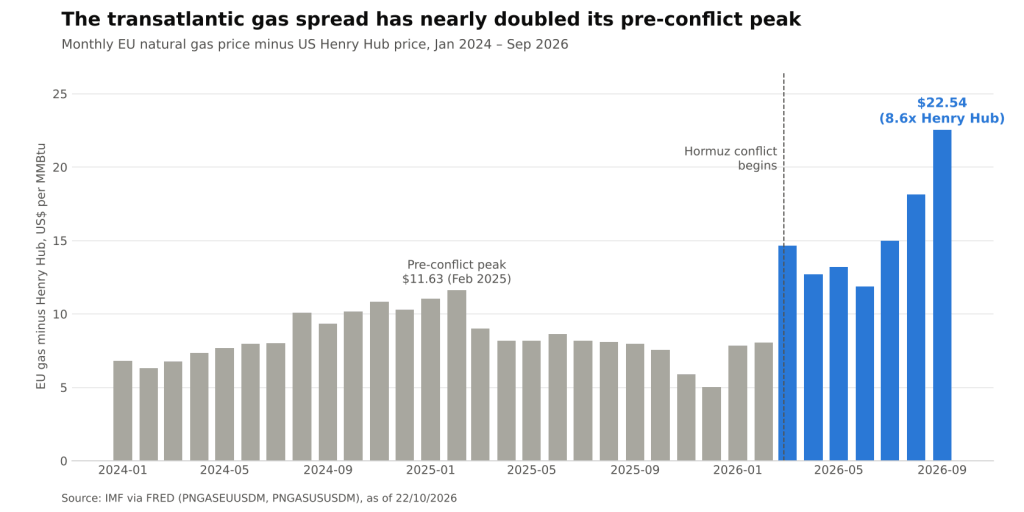
EU natural gas price minus US Henry Hub, monthly, US$/MMBtu (IMF via FRED @ 22/10/2026)
Why the Arbitrage Is Capped
The link between Henry Hub and overseas prices runs through a physical bottleneck: liquefaction capacity. Exports respond to price only while there is spare capacity. Once every train runs at full rate, a higher price abroad cannot move another molecule out of the Gulf Coast. The two markets separate, and Henry Hub goes back to being set by the US domestic balance.
The data suggest the US is close to that point:
- Exports at the limit. According to Rystad data cited by the American Gas Association, US LNG exports hit a record 19.9 Bcf/d on October 18, only 1.4% above the previous record set on March 28. Industrial Info Resources reported feedgas of just over 19 Bcf/d on October 27. Seven months of elevated overseas prices produced only a marginal new high in volumes.
- Ample supply at home. Year-to-date US output through October 29 was more than 4% above a year earlier, and pipeline exports to Mexico reached a record 7.7 Bcf/d on October 13. Storage stood at 3,724 Bcf in the week to October 23, 1% above the five-year average.
- Prices that clear the domestic market. With the export channel full, Henry Hub has to balance production against storage and power burn. The November contract expired at $2.82 on October 28, and December traded between $2.90 and $3.07 on October 29. Those prices reflect a well-supplied domestic market, not a global shortage.
New capacity adds flow only gradually. Golden Pass LNG, the newest Gulf Coast plant, doubled its exports to four cargoes in October. That is a ramp-up, not a step change. Until enough new trains come online to absorb the US supply surplus, the spread will be set by Europe and Asia and will not feed back into Henry Hub.
Who Captures the Spread
When the arbitrage is capped, the spread becomes a scarcity rent, i.e. a return earned by whoever controls the bottleneck. Who receives it depends on contract structure more than on the headline price:
- Offtakers with flexible destinations. Much US liquefaction capacity is sold under long-term tolling-style contracts, in which the buyer pays a fixed fee whether or not it lifts cargoes and takes the commodity margin itself. Portfolio players holding those rights earn most of the spread. They are also shifting cargoes toward Europe: shipments there rose to 6.89 MT in October from 5.91 MT in September, while Asia slipped to 2.73 MT from 2.84 MT.
- Exporters with uncontracted volumes. Plant owners collect fixed fees on contracted capacity regardless of spot prices. Their upside comes from commissioning cargoes and any capacity sold at spot or short-term prices. For credit analysis, this means fixed-fee cash flows stay stable, while the commodity exposure sits in a smaller merchant tranche.
- US gas consumers. Domestic power generators and industrial buyers keep a feedstock cost near $3 while overseas competitors pay about eight to nine times as much. This advantage is large, but it may not last, because it depends on liquefaction remaining the bottleneck.
The deal flow points the same way. On October 22, Cheniere’s Sabine Pass and Corpus Christi signed long-term agreements to supply QatarEnergy with 4 million tonnes per annum from the early 2030s to 2054. Plaquemines (13.5 mtpa design capacity) and Louisiana LNG (up to 5.2 mtpa, expected to be complete by 2030) belong to the same build-out. Each new train turns part of today’s scarcity rent into future Henry Hub demand.
What Would Close the Gap
Three developments could narrow the spread, and they would affect each side differently:
- Supply returns abroad. If Qatari force majeure ends and Hormuz flows recover, overseas prices fall toward Henry Hub plus the cost of shipping and liquefaction. The spread would close from the top, and Henry Hub would barely move.
- US capacity catches up. As new trains ramp up, more feedgas demand reaches the domestic market. The spread would close from below, and Henry Hub would carry more of the world price. AGA data show export-linked demand up 7.2% month-to-date in October, against 3.5% for domestic demand.
- A cold US winter. Storage is about 4% below year-ago levels. A demand shock at home would push up Henry Hub without any change abroad. This is the only route that lifts US prices quickly, and it has nothing to do with LNG.
Conclusion
The $22.54 transatlantic spread shows a physical constraint, not a mispricing. With US liquefaction near capacity, record export volumes have not raised Henry Hub, and the scarcity rent goes to holders of flexible offtake and merchant capacity rather than to US producers. Henry Hub still reflects a domestic market with strong output and comfortable storage.
Key items to watch: the pace of the Golden Pass ramp-up and other new trains, whether Qatar’s force majeure ends in early December as currently signaled, US storage withdrawals as winter begins, and the IMF’s October print on FRED, which will show whether the roughly $28 October average for TTF has widened the spread further.
Sources: FRED, IMF EU natural gas (PNGASEUUSDM); FRED, IMF Asia LNG (PNGASJPUSDM); FRED, IMF Henry Hub (PNGASUSUSDM); FRED, EIA Henry Hub spot (DHHNGSP); American Gas Association, Natural Gas Market Indicators, October 29, 2026; Reuters via BOE Report, November 2, 2026; Industrial Info Resources, October 28, 2026.
Daniel Panizo, CFA, FMVA


Leave a Reply