
Crude oil just had one of its worst weeks in decades. Reuters reported on Friday morning, 6 November, that Brent futures were on track for a weekly fall of roughly 16%, the steepest since the Covid crash, after the US midterm results lifted hopes of de-escalation in the Middle East and of more Gulf crude reaching the market. For anyone watching headline energy risk, that looks like relief.
The product market tells a more stubborn story. On the latest FRED prints (3 November), Brent spot stood at $107.03 a barrel, while New York Harbor ultra-low sulfur diesel (ULSD) traded at $4.823 a gallon, or about $203 a barrel. The gap between the two, i.e. the simple diesel crack spread, was $95.54 a barrel, more than three times its $27.06 level on 2 January. Crude is easing; the cost of turning crude into diesel is not. That distinction matters for inflation, for freight-heavy sectors and for how refining earnings should be read.
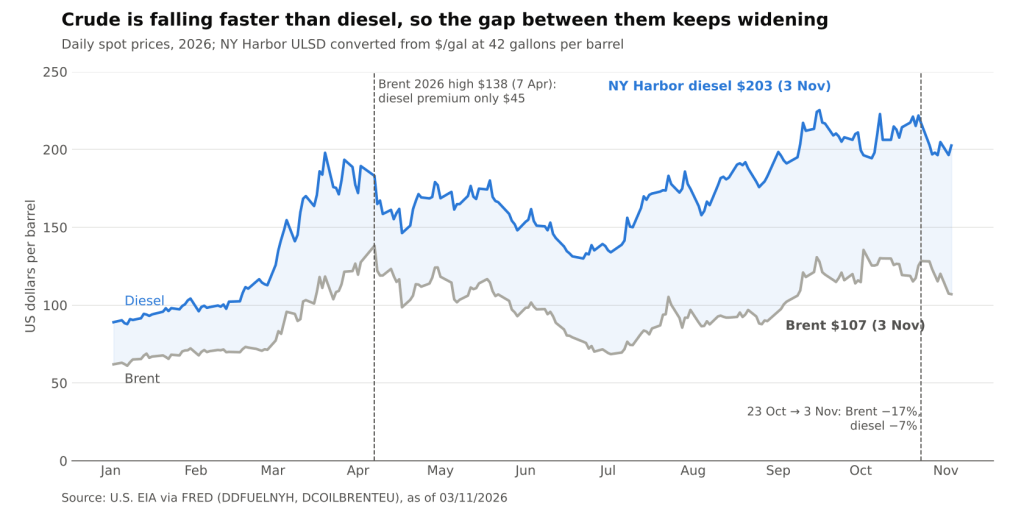
NY Harbor ULSD and Brent spot prices in US dollars per barrel, 2026 (U.S. EIA via FRED, DDFUELNYH and DCOILBRENTEU @ 03/11/2026)
From a Crude Shock to a Product Shock
The 2026 energy shock has moved through two distinct phases. In the spring, the stress sat in crude itself. Brent spot peaked at $138.21 on 7 April, yet on that same day the diesel crack was only $44.83. Diesel was expensive mainly because the raw material was expensive.
By the third quarter, the balance had flipped. Brent averaged $96.61 in Q3, below its Q2 average of $103.00, while the crack averaged $86.71, up from $55.26 in Q2. Lower crude, wider margins: the scarcity premium had migrated downstream from the barrel to the refined product. The crack hit its 2026 high of $105.91 on 20 October, when Brent was $115.22, well below its April peak.
Two simple measures capture the shift:
- Crack share of the diesel price. The crack accounted for about 30% of the per-barrel diesel price on 2 January and about 47% on 3 November. Nearly half of what buyers now pay for diesel is processing and scarcity premium rather than crude cost.
- Weaker co-movement. The correlation of daily price changes between Brent and NY Harbor diesel fell from 0.73 in the first half of 2026 to 0.43 from July through 3 November. Diesel is increasingly trading on its own fundamentals.
The Last Two Weeks in Miniature
The recent sell-off shows the asymmetry clearly. Between 23 October and 3 November, Brent spot fell from $128.30 to $107.03, a decline of 16.6%. Over the same window, NY Harbor diesel fell only 6.6%, from $5.162 to $4.823 a gallon. As a result, the crack widened by about $7, from $88.50 to $95.54 a barrel.
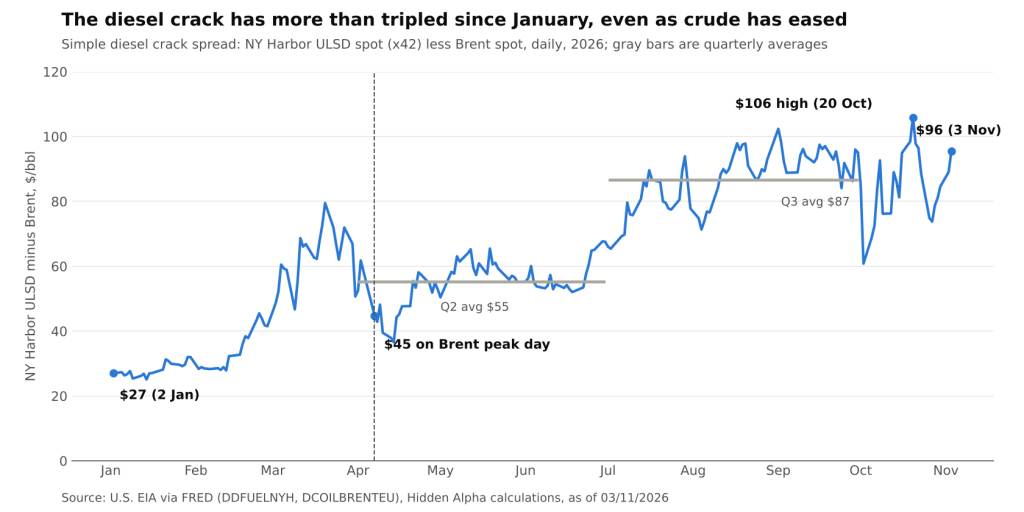
Simple diesel crack spread, NY Harbor ULSD less Brent spot, US dollars per barrel, 2026 (U.S. EIA via FRED, DDFUELNYH and DCOILBRENTEU, Hidden Alpha calculations @ 03/11/2026)
Why would diesel lag crude on the way down? Several mechanisms are consistent with the data:
- Crude relief is a barrel story; diesel relief is a capacity story. More crude exports from the Gulf ease feedstock costs, but they do not create refining capacity. If refiners are already running near their limits, extra crude cannot quickly become extra diesel.
- Utilization is already stretched. Valero said its refineries operated at near-record utilization in the third quarter, with throughput of about 3.0 million barrels per day. A system running flat out has little room to respond to high margins with more output.
- Distillates carry the heaviest disruption premium. Diesel and jet fuel move through the same shipping lanes that have been disrupted, and Reuters noted that tanker attacks in the Gulf and the Strait of Hormuz are running near a record pace. A ceasefire narrative can reprice crude futures in days; rerouted product cargoes and strained product logistics take longer to normalize.
- Seasonality cuts the wrong way. The Northern Hemisphere is entering the heating season, when distillate demand typically rises, so the market has little reason to rebuild a large inventory cushion quickly.
Who Captures the Spread
A wide crack is a transfer from fuel buyers to refiners, and the third-quarter results make the scale visible. Valero reported net income attributable to stockholders of $6.8 billion, or $23.89 per share, versus $1.1 billion, or $3.53 per share, a year earlier. Refining operating income rose to $8.8 billion from $1.6 billion. The company returned cash equal to 52% of adjusted operating cash flow, a payout ratio that leaves much of the windfall on the balance sheet rather than committing it to recurring distributions.
For analysts, the key point is that these earnings are driven by the spread, not by crude. A refiner’s profitability depends on the product crack and its ability to capture it, so a falling oil price is not, by itself, a negative signal for the sector. The relevant variable is whether the product premium compresses, and that depends on refining and logistics constraints more than on crude headlines.
Implications Beyond Refining
- Inflation pass-through. Diesel feeds directly into freight, agriculture and construction costs. If headline crude falls while diesel stays near $4.80 a gallon, goods inflation may ease more slowly than an oil-price rule of thumb would suggest. Reading lower Brent as broad disinflation risks overstating the relief.
- Margin pressure for diesel-intensive sectors. Trucking, airlines (via jet fuel, a close distillate cousin), chemicals and mining face input costs that are tied to the product price, not to Brent. Hedging programs referenced to crude can leave these firms exposed to basis risk, i.e. the gap between the hedged benchmark and the fuel actually consumed.
- Earnings quality. Outsized refining profits rest on a spread that is unusually wide by recent standards. Valuation work should treat the current crack as a cyclical peak input, not a run-rate, and stress-test cash flow at more normal spreads.
Conclusion
The headline oil narrative has shifted to relief, but the diesel market has not followed. A crack spread near $96 a barrel, close to half the diesel price, shows that the binding constraint in 2026 is no longer crude supply alone but the system that turns crude into usable fuel. Lower Brent helps; it does not by itself unwind a product shortage.
What to watch next: whether the crack narrows as crude falls further, refinery utilization and distillate inventory data from the EIA, product-tanker security in the Gulf, and the heating-season draw. The next FRED update of the spot series is due on 12 November. A narrowing crack would confirm that relief is reaching end users; a stable or wider one would mean the energy shock has simply changed form.
Sources: FRED, NY Harbor ULSD spot (DDFUELNYH); FRED, Brent spot (DCOILBRENTEU); Valero Energy, Third Quarter 2026 Results; Reuters via RTÉ, oil set for sharp weekly drop (6 November 2026).
Daniel Panizo, CFA, FMVA



Leave a Reply