
For most of 2025, Berkshire Hathaway sat on a cash pile of more than $350 billion and bought back none of its own stock. That changed decisively in the third quarter of 2026. According to the company’s November 7 release, Berkshire repurchased roughly $9.6 billion of its shares in the three months to September 30, bringing the nine-month total to about $14.4 billion. The Q3 figure alone equals about 76% of the quarter’s $12.7 billion in operating earnings.
The timing matters. Greg Abel took over as CEO on January 1, 2026, and the buyback program is explicitly tied to the CEO’s judgment of intrinsic value. A quarter in which the company spends three-quarters of its operating profit on its own stock is therefore less a routine capital return than a statement about how management views the price of Berkshire relative to what it is worth, and about where the next dollar of capital earns the most.
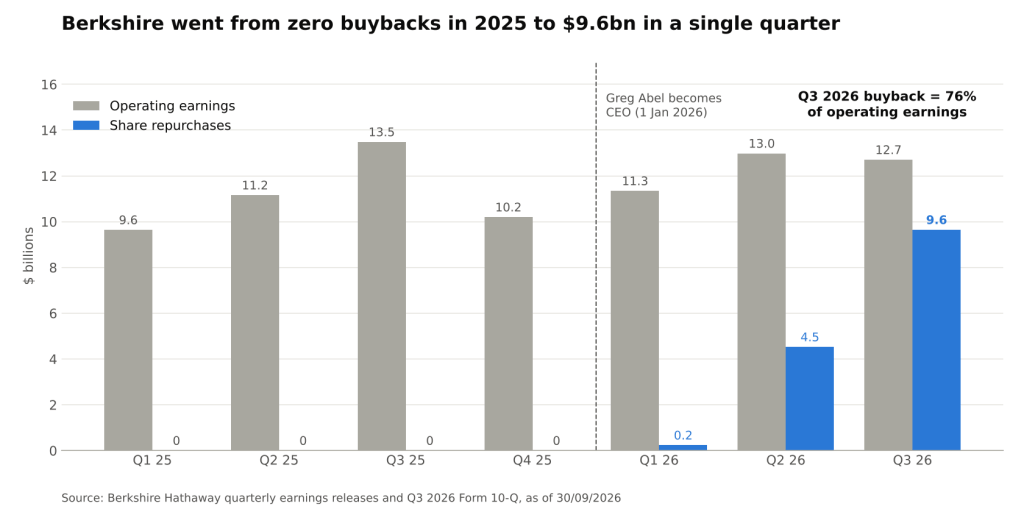
Berkshire quarterly operating earnings vs share repurchases, $bn (Berkshire Hathaway earnings releases and Q3 2026 Form 10-Q @ 30/09/2026)
The Policy Behind the Number
Berkshire does not run a programmatic buyback. Its 10-Q states that it may repurchase shares at prices below intrinsic value, as conservatively determined by the CEO after consultation with the Chairman, with no minimum or maximum amount. The only hard constraint is a liquidity floor: repurchases stop if consolidated cash, cash equivalents and Treasury bills would fall below $30 billion.
That floor is nowhere near binding. At September 30, 2026, the insurance and other businesses held $352.3 billion in cash, equivalents and T-bills (net of unsettled purchases), roughly 11.7x the floor. When liquidity is this abundant, the volume of buybacks is set almost entirely by the valuation test. That is what makes the ramp from $235 million in Q1 to $4.5 billion in Q2 and $9.6 billion in Q3 informative: each step up implies management saw a wider or more persistent gap between price and its estimate of value.
For context, Reuters notes that Berkshire’s largest buyback year was 2021, at about $27 billion. The nine-month 2026 total is already about 53% of that peak, with a quarter still to report.
Where the Capital Went
Buybacks were not the only call on cash in 2026. The year opened with the OxyChem acquisition, completed on January 2 for about $9.4 billion in cash, followed by Taylor Morrison, completed on July 24 for about $6.8 billion in cash (an enterprise value of roughly $8.5 billion, i.e. including assumed debt). Tallying the three main uses gives a clear picture of the capital allocation hierarchy:
- Acquisitions: about $16.2 billion across OxyChem and Taylor Morrison, the classic Berkshire preference for buying whole businesses.
- Repurchases: about $14.4 billion, concentrated in the second and third quarters.
- Combined: about $30.6 billion, or roughly 83% of nine-month operating earnings of $37.0 billion.
The net cash and T-bill position fell from $369.0 billion at year-end 2025 to $352.3 billion, a decline of $16.7 billion, with portfolio activity also feeding into that change. The pile remains enormous, but the direction has turned: Berkshire is deploying capital at a pace close to what its businesses generate, rather than simply accumulating Treasury bills.
The Earnings Backdrop: Buying While Profits Dip
The step-up in repurchases did not coincide with a surge in profits. Q3 operating earnings fell about 5.8% year on year, from $13.5 billion to $12.7 billion, even as Reuters reported revenue up about 11%. The drag came from insurance:
- Underwriting: after-tax underwriting profit dropped to $1.35 billion from $2.37 billion, a decline of about 43%.
- Insurance investment income: fell about 14% to $2.73 billion from $3.18 billion, reflecting lower income on the cash and T-bill book.
- Operating businesses: BNSF rose about 19% to $1.73 billion, and manufacturing, service and retailing rose about 12% to $4.04 billion.
Two analytical points follow. First, a buyback that accelerates while quarterly earnings soften is a valuation decision, not a mechanical distribution of surplus profit. Second, falling investment income on the cash book lowers the opportunity cost of using that cash. When idle liquidity yields less, the hurdle a repurchase must clear (i.e. the return on buying a dollar of intrinsic value for less than a dollar) becomes easier to justify relative to holding T-bills. For the nine months, operating earnings were still up about 8.0% to $37.0 billion, so the quarterly dip did not change the broader capacity to fund both deals and buybacks.
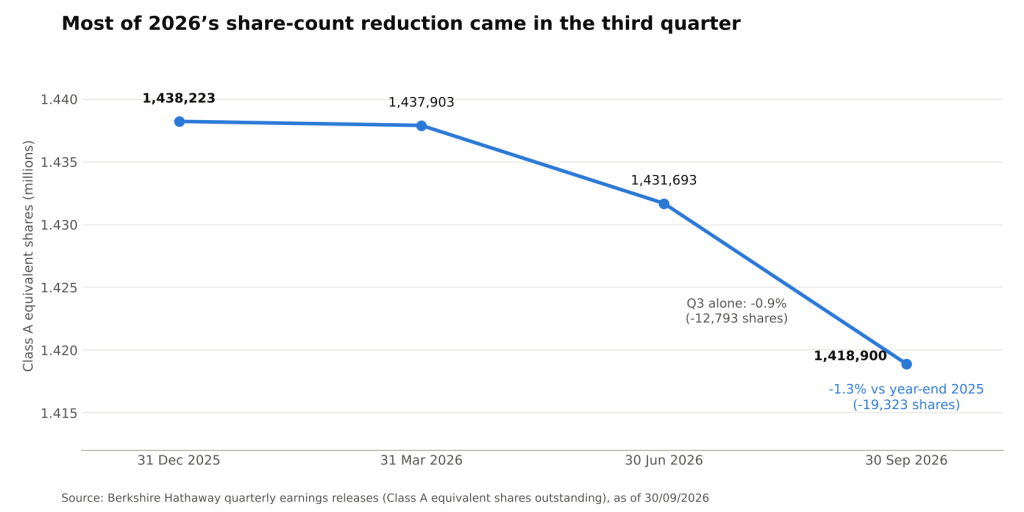
Berkshire Class A equivalent shares outstanding (Berkshire Hathaway earnings releases @ 30/09/2026)
The Per-Share Arithmetic
The buybacks show up directly in the share count. Class A equivalent shares fell from 1,438,223 at year-end 2025 to 1,418,900 at September 30, a reduction of 1.3%. About two-thirds of that came in Q3 alone, when the count dropped by 12,793 shares, or 0.9%. The cover of the 10-Q suggests the process continued: share counts as of October 28 imply roughly 1,416,346 Class A equivalents, about 0.2% below the September 30 figure.
The mechanics are worth spelling out for anyone modeling the stock:
- Accretion depends on price, not volume. Repurchasing below intrinsic value transfers value from selling to remaining shareholders; repurchasing above it does the reverse. The size of the program matters less than the discount at which it is executed.
- Per-share metrics move mechanically. With roughly 1.3% fewer shares, each remaining share carries a proportionally larger claim on earnings and on book value, even with no change in the underlying business.
- Book value still grew. Berkshire shareholders’ equity rose $43.9 billion in the nine months to $761.4 billion, despite $14.4 billion of capital returned through repurchases.
- Signal of succession style. The program is the most visible capital allocation choice of the new CEO, and its scale offers an early read on how actively the post-Buffett management intends to use the balance sheet.
Conclusion
Berkshire’s Q3 buyback is notable less for its absolute size than for what it implies. With liquidity at roughly 11.7x its self-imposed floor, the only real gate is management’s view of intrinsic value, and that gate opened wider each quarter of 2026. Combined with two cash acquisitions, Berkshire has deployed about 83% of its nine-month operating earnings, turning the cash pile from a growing stockpile into a slowly declining one.
What to watch next: whether repurchases persist in Q4 as the share price moves, how insurance underwriting margins evolve after a weak quarter, and how the next annual letter frames the trade-off between buying businesses and buying back stock. A sustained program at this pace would mark a durable shift in how the company recycles its excess capital.
Sources: Berkshire Hathaway Q3 2026 earnings release; Berkshire Hathaway Q3 2026 Form 10-Q; Q2 2026 release; Q1 2026 release; Q4 2025 release; Taylor Morrison announcement; Reuters via GV Wire.
Daniel Panizo, CFA, FMVA



Leave a Reply