
Crude oil has cooled sharply this month. WTI spot fell from $107.56 per barrel on 30 October to $89.53 on 17 November, a drop of $18.03, or 16.8%. Read through a crude lens, that looks like an energy shock unwinding. Read through the refined-product market, it looks very different: the barrel has split in two.
On 17 November, New York Harbor ultra-low-sulfur diesel (ULSD) traded $82.38 per barrel above WTI, while New York Harbor conventional gasoline traded only $8.25 above it. That $74.13 gap between the two crack spreads (i.e. the margin between a refined product’s price and the crude it is made from) is the clearest signal in energy markets right now. It says the shortage is not in crude oil but in the middle of the barrel.
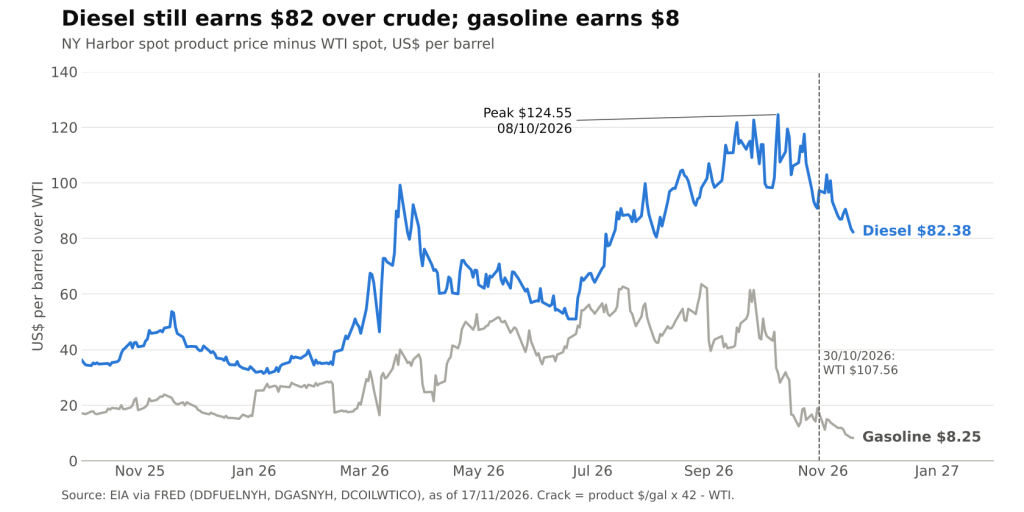
NY Harbor diesel and gasoline crack spreads versus WTI, US$ per barrel (EIA via FRED: DDFUELNYH, DGASNYH, DCOILWTICO @ 17/11/2026)
How the Crack Is Measured
The spreads here are simple and fully reproducible from public data. The EIA publishes daily spot prices for NY Harbor ULSD and NY Harbor conventional gasoline in dollars per gallon, and WTI at Cushing in dollars per barrel. Multiplying the product price by 42 (gallons per barrel) and subtracting WTI gives a single-product crack. It is not a refiner’s realized margin, since it ignores yields, freight, compliance costs and crude differentials, but it is a clean gauge of how scarce each product is relative to its feedstock.
On that basis, the numbers are stark:
- Peak: the diesel crack reached $124.55 on 8 October 2026, the high of the series since October 2025.
- Now: at $82.38, it is down from the peak but still above its $48.16 level of a year earlier and roughly double its $39.67 average in the fourth quarter of 2025.
- Gasoline: the gasoline crack peaked at $63.56 on 28 August and has since fallen to $8.25, well below its fourth-quarter 2025 average of $18.64.
- Share of the price: the diesel crack now accounts for 47.9% of the spot price of a barrel of ULSD. Almost half of what a buyer pays for diesel is refining scarcity rather than crude.
What the Last Three Weeks Reveal
The period since 30 October is a useful natural experiment, because crude fell hard while product fundamentals had little time to change. The decomposition shows that products did not move in lockstep:
- Crude: WTI fell $18.03 per barrel (-16.8%).
- Diesel: ULSD fell $32.89 per barrel (-16.1%), roughly the same percentage as crude. Because diesel starts from a much higher price, a proportional move means a larger dollar drop, and the crack narrowed by $14.86.
- Gasoline: gasoline fell $26.88 per barrel (-21.6%), faster than crude in percentage terms, and its crack compressed by $8.85 to a level that leaves little margin on the gasoline barrel.
The distinction matters. Diesel has essentially been repricing in line with crude, holding its premium in percentage terms. Gasoline has been repricing below crude. On a month-to-date basis through 17 November, the diesel crack averaged $91.45 and the gasoline crack $11.72. Part of the gasoline weakness is seasonal, as winter-grade gasoline is cheaper to blend and driving demand softens in the fourth quarter, while distillate demand is supported by heating, freight and harvest. But seasonality alone does not produce a ten-to-one ratio between the two cracks.
The Inventory Side of the Story
Product prices this high are a symptom of thin buffers, and the EIA’s weekly inventory data confirm it. US distillate fuel oil stocks stood at 104.3 million barrels in the week ending 16 October 2026, against 115.6 million in the comparable week of 2025, a shortfall of 11.3 million barrels, or 9.7%. The 2026 low through mid-October was 100.8 million barrels in late May, and the usual summer and early-autumn rebuild that lifted 2025 stocks above 120 million barrels never materialized.
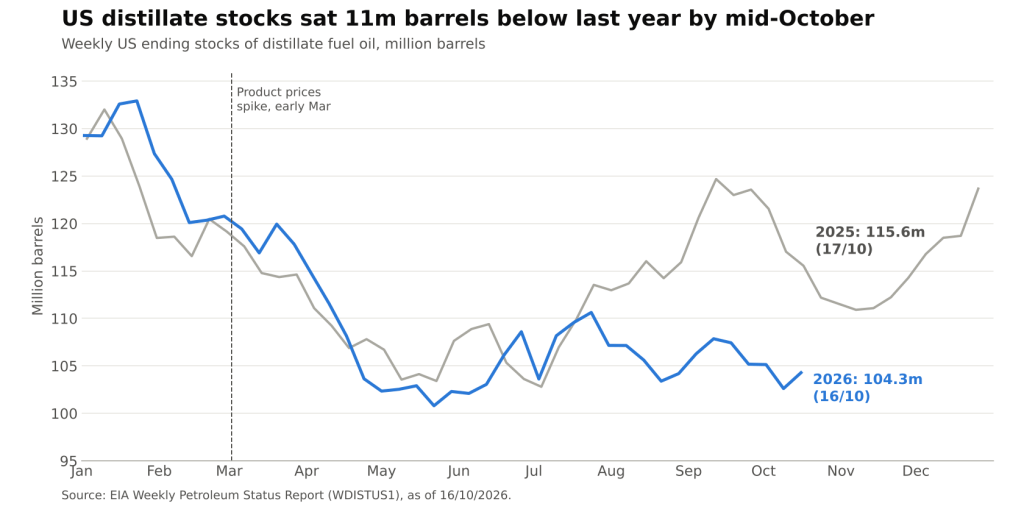
Weekly US ending stocks of distillate fuel oil, 2026 vs 2025, million barrels (EIA WDISTUS1 @ 16/10/2026)
Later weekly reports pushed the picture further. EIA data for the week ending 30 October put distillate stocks at 99.3 million barrels, the first reading below 100 million since May 2003 and about 13% below the five-year seasonal average, as reported by S&P Global and others. Going into the heating season, that is a thin cushion for a fuel that also moves trucks, trains, farm equipment and ships.
Why the Barrel Cannot Simply Rebalance
The intuitive fix for a diesel shortage is to refine more crude. The mechanics of refining make that harder than it sounds:
- Joint production: a refinery cannot make diesel without also making gasoline and other products. Running harder to capture an $82 diesel margin also adds gasoline into a market already paying only $8 over crude, which caps how much incremental throughput makes sense.
- Yield limits: refiners can shift cut points and run modes toward distillate, but only within the limits of each plant’s hydrocracking and hydrotreating capacity. Those units, not crude supply, are the binding constraint when middle distillates are short.
- Crude is the wrong lever: cheaper crude lowers the price of every product but does not create distillate capacity. That is why diesel fell roughly in line with WTI in percentage terms while its absolute premium stayed near historic highs.
For analysts, this means the headline oil price is now a poor proxy for energy-cost pressure. Freight, logistics, agriculture and airlines buy middle distillates, not crude, and their input cost is set by the diesel crack as much as by WTI. A 17% fall in crude delivered close to a 16% fall in wholesale diesel, but from a starting point where almost half the price was refining premium.
Implications Across Sectors
- Refiners: earnings sensitivity now sits heavily in distillate yield. Plants with high diesel output capture most of the margin, while gasoline-heavy configurations are far less advantaged than a headline 3-2-1 crack might suggest.
- Diesel-intensive users: trucking, rail, airlines and agriculture face fuel costs that crude-based hedges only partly offset. A crude hedge leaves the crack exposure open, and at $82 that basis risk is large.
- Inflation readings: diesel feeds into transport and goods prices with a lag, so the drop in crude is unlikely to translate one-for-one into lower freight-driven costs while the distillate premium remains elevated.
Conclusion
The November slide in crude has not resolved the 2026 energy squeeze; it has exposed where the squeeze actually sits. With the diesel crack at $82.38 against $8.25 for gasoline as of 17 November, and distillate stocks running well below last year, the scarcity is in refining capacity for middle distillates rather than in crude supply.
The indicators to watch are straightforward: whether weekly EIA distillate stocks rebuild back above 100 million barrels as the heating season begins, whether the diesel crack holds its percentage premium as crude moves, and whether gasoline cracks near single digits start to restrain refinery runs. A narrowing of the diesel-gasoline gap would be the clearest sign that the barrel is coming back together.
Sources: EIA via FRED, NY Harbor ULSD spot (DDFUELNYH); EIA via FRED, NY Harbor conventional gasoline spot (DGASNYH); EIA via FRED, WTI spot (DCOILWTICO); EIA, Weekly US Ending Stocks of Distillate Fuel Oil (WDISTUS1); S&P Global Commodity Insights.
Daniel Panizo, CFA, FMVA



Leave a Reply