
NVIDIA’s fiscal third quarter, reported on 17 November, delivered another set of headline records: revenue of $115.8 billion, up 103% from a year earlier, and GAAP net income of $65.3 billion. The income statement, however, tells only half of the story. Over the same quarter the company generated $43.8 billion of free cash flow (FCF, i.e. operating cash flow less capital spending, as NVIDIA defines it), which is just 67% of reported net income.
Across the first nine months of fiscal 2027 the gap is wider still. Net income totaled $183.3 billion; free cash flow came in at $113.7 billion, a 62% cash conversion rate. For a business this profitable, that roughly $69.6 billion difference deserves a line-by-line explanation, because it says a great deal about how the AI buildout is being financed and who is carrying the working capital.
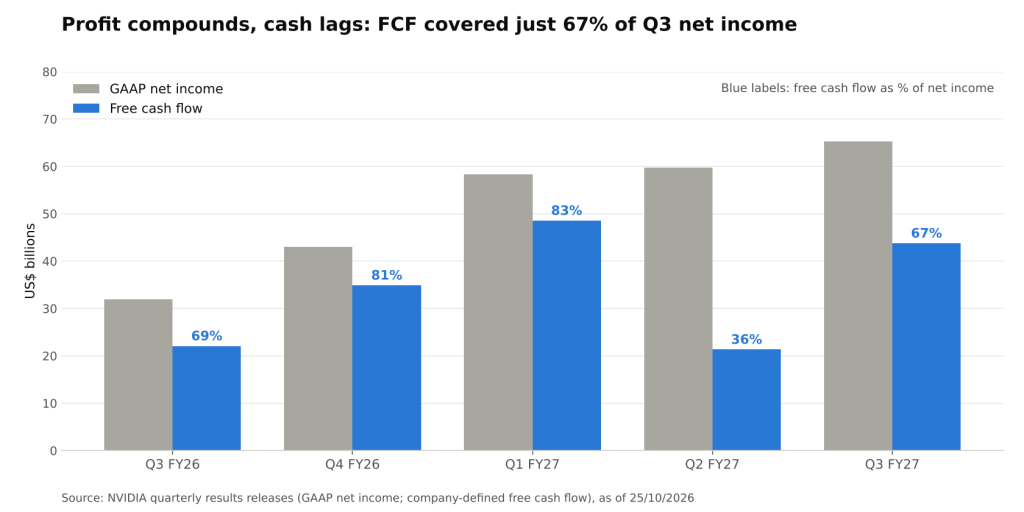
NVIDIA quarterly GAAP net income vs free cash flow, with FCF as a share of net income (NVIDIA results releases @ 25/10/2026)
Where the Missing Cash Went
The reconciliation from net income to operating cash flow in NVIDIA’s cash flow statement isolates three items that explain almost all of the nine-month shortfall:
- Receivables: rising accounts receivable absorbed $42.6 billion of cash. Revenue is booked when product ships, but the cash arrives only when customers pay.
- Inventories: another $18.4 billion went into inventory, which rose from $21.4 billion to $39.7 billion (+86%) as the company built ahead of the Vera Rubin ramp.
- Investment gains: net income includes $25.5 billion of gains on equity securities, i.e. mark-to-market and realized gains on NVIDIA’s stakes in other companies. These lift reported earnings but are not operating cash.
Receivables and inventory together absorbed $61.0 billion in nine months. Stripping out the equity gains gives a cleaner comparison: on non-GAAP net income of $164.4 billion, which excludes those gains, FCF conversion improves to 69%. That is better, but still well below the 81–83% delivered in the two quarters before the second-quarter dip.
Receivables Are Outrunning Revenue
The single most important line is accounts receivable. It stood at $38.5 billion at the end of fiscal 2026 (25 January) and reached $81.0 billion by 25 October, an increase of 111%. Over the same span, quarterly revenue rose from $68.1 billion in the fourth quarter of fiscal 2026 to $115.8 billion, an increase of 70%. Receivables now equal about 70% of a full quarter’s sales.
A simple proxy for collection time, period-end receivables divided by quarterly revenue and scaled to a 91-day quarter, was about 51 days in January and 45 days in April, then jumped to about 64 days by October. The step change came in the second quarter: when NVIDIA reported in August, days sales outstanding (DSO) had risen to 60 from 45, which the company attributed to extended payment terms on large, multi-quarter agreements with certain investment-grade customers. Q2 is where conversion dropped to 36%, and the third quarter did not reverse it: receivables absorbed a further $18.1 billion of cash, after $22.3 billion in the second quarter.
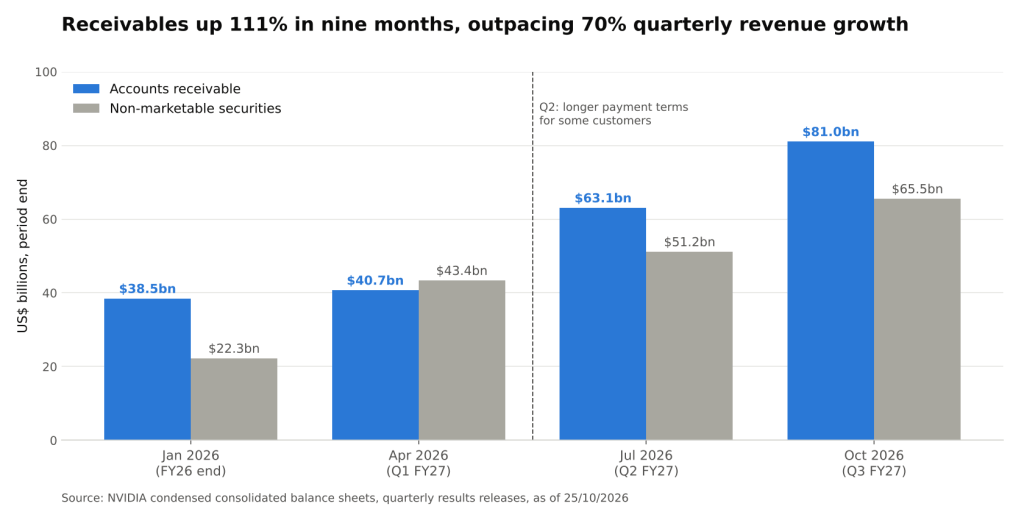
NVIDIA accounts receivable and non-marketable securities at each quarter-end (NVIDIA balance sheets @ 25/10/2026)
Vendor Financing by Another Name
Longer payment terms are a form of credit. When a supplier lets customers pay later, it is effectively lending them working capital, and the cost shows up as slower cash conversion rather than as interest expense. Three features of NVIDIA’s balance sheet make this worth watching closely:
- Customer concentration: the extended terms were granted on large, multi-quarter contracts. Receivables of this size are concentrated in relatively few counterparties, so collection risk is less diversified than the headline revenue suggests.
- Equity stakes in the ecosystem: non-marketable securities, i.e. private holdings that do not trade on an exchange, rose from $22.3 billion to $65.5 billion, almost tripling in nine months. When a supplier both extends terms to and invests in parts of its customer base, the credit exposure and the equity exposure can move together.
- Balance sheet funding: long-term debt rose from $7.5 billion to $32.4 billion after a $24.9 billion note issuance. Cash generation remains very large, but it is no longer the only source of funds.
None of this points to stress today. NVIDIA’s customers in these contracts are described as investment grade, and nine-month FCF of $113.7 billion remains exceptionally large in absolute terms. The analytical point is narrower: a growing share of reported profit is sitting on the balance sheet as claims on customers rather than in the bank.
What It Means for Capital Returns and Valuation
Lower conversion matters most for how far cash stretches. In the first nine months NVIDIA spent $61.2 billion on buybacks and $12.3 billion on dividends, a combined $73.5 billion or 65% of FCF. That leaves a comfortable buffer, but the buffer is smaller than an earnings-based payout ratio would suggest. Three implications follow:
- Earnings-based multiples flatter cash yield. A price-to-earnings ratio built on GAAP net income implicitly assumes full conversion. At 62% conversion, the free cash flow yield is correspondingly lower than the earnings yield.
- Working capital becomes a swing factor. If customers pay on the longer terms as contracted, receivables should stabilize relative to revenue and conversion should recover. If terms lengthen again, cash flow can lag profit for several more quarters.
- Margin and cash both face a near-term headwind. Fourth-quarter guidance calls for revenue of $130.0 billion, plus or minus 3%, with gross margin of 71–72%, down from 74.8%, as the Vera Rubin ramp adds cost. A larger quarter also means more inventory and more receivables to fund.
The wider context reinforces why the cash line matters. In the Federal Reserve’s November Financial Stability Report, 87% of surveyed market contacts cited AI as a salient risk to the financial system. Supplier financing is one channel through which a slowdown in AI capex could surface early, in slower collections before any change in a supplier’s reported revenue.
Conclusion
NVIDIA’s third quarter confirms very strong demand, but its cash flow statement shows the cost of winning it. Receivables have grown 111% since January against 70% growth in quarterly revenue, extended payment terms have pushed the receivable-days proxy from about 45 in April to about 64 in October, and nine-month free cash flow covers only 62% of reported net income. Part of the gap is accounting noise from equity gains; most of it is working capital, led by receivables that amount to credit extended to customers.
The items to watch in the fiscal fourth-quarter report are receivables relative to revenue, any further change in payment terms disclosed in the 10-Q, the trajectory of non-marketable investments, and whether FCF conversion moves back toward the 80% range. A stabilizing receivables line would suggest the second-quarter step was a one-off reset of terms; a further climb would mean cash flow keeps trailing the income statement as the buildout scales.
Sources: NVIDIA, Q3 FY2027 results release (17/11/2026); NVIDIA, Q2 FY2027 results release (26/08/2026); NVIDIA, Q1 FY2027 results release (20/05/2026); Zacks via Nasdaq, Q2 FY2027 review citing DSO commentary; Federal Reserve, Financial Stability Report (November 2026).
Daniel Panizo, CFA, FMVA



Leave a Reply