
On 9 November 2026, Moody’s Ratings affirmed Alstom’s Baa3 long-term issuer rating and revised the outlook to negative from stable. Baa3 is the lowest investment-grade notch on Moody’s scale, so a negative outlook on it carries more weight than the same signal one or two notches higher: the next step down is Ba1, i.e. speculative grade, where investment-grade-only mandates can no longer hold the paper. The action came a week after Alstom cut its fiscal 2026/27 guidance on 2 November, and the full first-half results published on 17 November showed why.
The case is instructive because Alstom has been here before. Moody’s moved the same Baa3 to negative outlook in October 2023, and the company answered with a roughly €2 billion deleveraging plan that brought the outlook back to stable in June 2024. The balance-sheet repair that plan delivered has now largely been reversed in a single half-year.
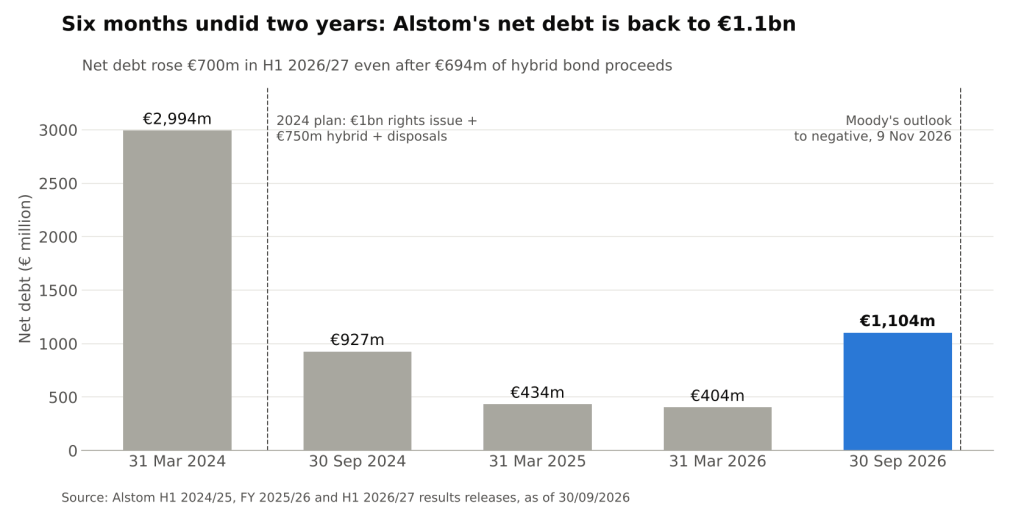
Alstom net debt at selected reporting dates, € million (Alstom results releases @ 30/09/2026)
What Moody’s did and why
Moody’s left every rating unchanged and only moved the outlook, which signals that the agency sees a meaningful chance of a downgrade over the outlook horizon without concluding that the credit has already slipped below Baa3. Press coverage of the action reported that Moody’s doubts Alstom can restore its key credit metrics to levels consistent with the rating within the next 12 to 18 months, and pointed to an uneven record of contract execution.
The trigger was operational rather than financial engineering. In the half-year to 30 September 2026, Alstom reported:
- Adjusted EBIT of €(396) million, against €580 million a year earlier, a swing of €976 million.
- Adjusted EBIT margin of (4.2)%, down 1,060bp from 6.4%; the company attributes 1,000bp of that to project execution, mainly gross margin revisions on contracts executed for and from Germany, led by the Coradia Max regional train platform.
- Funds from operations of €(628) million versus €411 million, i.e. cash from operations before working capital turned negative.
- Free cash flow of €(1,248) million, versus €(740) million in the prior-year half.
- Net loss (Group share) of €954 million.
Full-year guidance now calls for an adjusted EBIT margin of around 1% and free cash flow of €(1.5) billion, compared with around 6.5% and positive free cash flow before 2 November.
The metrics against the thresholds
Moody’s rates Alstom under its Global Manufacturing Companies methodology. The most recent set of rating triggers Alstom disclosed came with the October 2023 action; the November 2026 release did not restate them, so they are a reference point rather than a confirmed current scorecard. Moody’s also computes its own adjusted EBITA margin, which differs from Alstom’s adjusted EBIT, so the comparison below is directional.
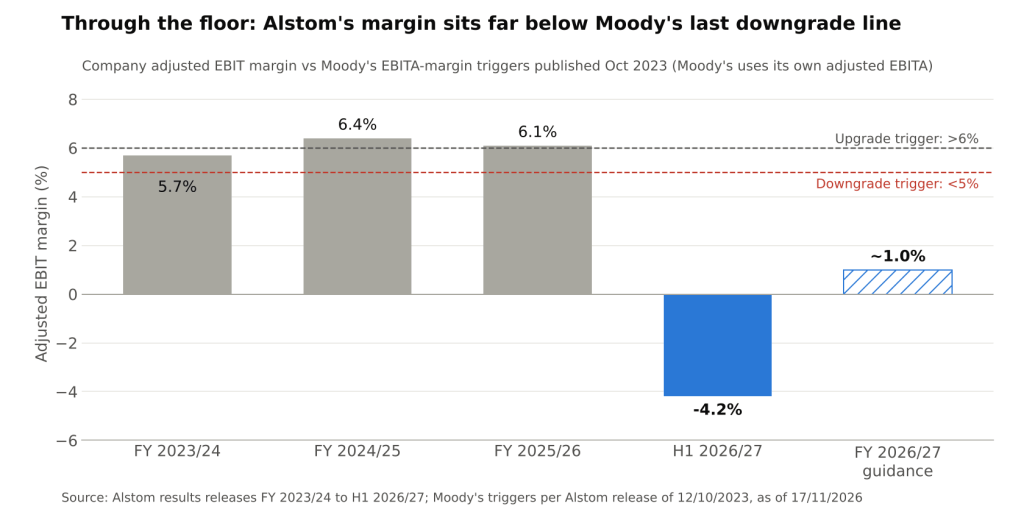
Alstom adjusted EBIT margin vs Moody’s EBITA-margin triggers published October 2023 (Alstom results releases; Moody’s via Alstom @ 17/11/2026)
| Factor | Downgrade trigger (Oct 2023) | Upgrade trigger (Oct 2023) | Alstom latest |
|---|---|---|---|
| Moody’s-adjusted EBITA margin | <5% | >6% | Adj. EBIT margin (4.2)% in H1; ~1% FY guidance |
| Moody’s-adjusted gross debt/EBITDA | 3.75x | <2.75x | Not meaningful on H1: EBITDA before PPA + JV dividends €(162)m |
| Liquidity | FCF < 0 | FCF > 0 | FCF €(1,248)m in H1; €(1.5)bn FY guidance |
| Financial policy | Less conservative | Conservative | €2bn deleveraging target by Sep 2027 |
On a straight reading of fiscal 2026/27 guidance, two of the three quantitative downgrade conditions, margin and free cash flow, are clearly met, and the third cannot be measured cleanly. Between fiscal 2023/24 and 2025/26, the margin sat between 5.7% and 6.4%, inside or just above the band separating the two triggers. The H1 figure is not a near miss; it is roughly 9 percentage points below the downgrade line. Leverage cannot be read cleanly from a half in which EBITDA before PPA and JV dividends was €(162) million, against €801 million a year earlier, which is precisely why an agency looks through to the forward path.
Net debt tells the same story in balance-sheet terms. It rose by €700 million in six months, to €1,104 million from €404 million, and that was after €694 million of proceeds from a €700 million green hybrid bond issued in June. Without that issue, net debt would have been close to €1.8 billion. The full-year free cash flow guidance implies only about €(252) million of further burn in the second half, which assumes the second-half margin recovers to around 6.5%.
Why the outlook, not the downgrade
Three features of the credit explain why Moody’s stopped at an outlook change:
- Liquidity is ample. Cash and equivalents stood at €1,625 million at 30 September, alongside an undrawn €2.5 billion revolving credit facility maturing in July 2029 and a €1.75 billion backstop facility maturing in January 2029 that backs the commercial paper programme, on which nothing was outstanding. On 1 November Alstom added a further €2.0 billion facility, free of financial covenants, maturing in November 2028.
- The backlog is large. Orders reached €11.0 billion in the half, a book-to-bill of 1.2, and the backlog stood at €111 billion. The issue is converting contracts into cash, not winning them.
- Management has committed to a remedy. The board is reviewing organic measures, disposals and equity or equity-like funding to reduce debt by around €2 billion by September 2027, with an explicit objective of keeping a solid investment-grade rating.
The 2024 precedent is the template the market will measure against. That plan combined a €1 billion rights issue, a €750 million hybrid bond with 50% equity credit from Moody’s, and roughly €700 million of announced disposals. Alstom said the combined proceeds of about €2.4 billion equated to about €2 billion of deleveraging on Moody’s basis, and the outlook returned to stable on 13 June 2024 once the rights issue closed. Net debt fell from €2,994 million in March 2024 to €927 million six months later.
What would move the rating next
The path back to stable or toward Ba1 rests on a small number of observable items:
- Second-half delivery. Guidance requires a swing from a negative margin to around 6.5% in H2. Further gross margin revisions on German contracts would undermine the forward metrics the agency is relying on.
- Execution of the €2 billion plan. Its composition matters. Equity and disposals reduce debt one for one; hybrids receive only partial equity credit, so the same headline amount delivers less deleveraging on Moody’s metrics.
- Coradia Max homologation. Delays push milestone payments into later years, which is the main reason free cash flow guidance moved from positive to €(1.5) billion.
- The medium-term framework. Alstom expects performance to normalize from fiscal 2027/28 and to trend toward an 8 to 10% adjusted EBIT margin, with details at a Capital Markets Day in the second quarter of 2027.
Bond spread data for Alstom’s own issues is not available from a primary public source, so this post does not quantify how the market is pricing the risk of a move to Ba1. The structural point holds regardless: for a Baa3 issuer on negative outlook, the gap between today’s spread and a high-yield spread is the cost the deleveraging plan is designed to avoid.
Conclusion
Moody’s negative outlook on Alstom reflects a sharp break in operating performance rather than a gradual drift: a margin that sat around the 5 to 6% trigger band for three years fell to (4.2)% in one half, and cash burn wiped out most of the deleveraging achieved in 2024. Ample liquidity and a committed €2 billion plan explain why the rating itself held at Baa3.
The items to watch are the third-quarter orders and sales update on 19 January 2027, any announcement on the size and mix of the deleveraging measures, and full-year results on 12 May 2027, which will show whether the second-half recovery in margin and cash flow materialized.
Sources: Alstom, Moody’s affirms Baa3, outlook negative (9 Nov 2026); Alstom H1 2026/27 results (17 Nov 2026); Alstom FY 2025/26 results; Alstom, Moody’s rating action and triggers (12 Oct 2023); Alstom, rights issue completion (13 Jun 2024); Alstom H1 2024/25 results; ABC Bourse on the Moody’s action.
Daniel Panizo, CFA, FMVA



Leave a Reply