
On 20 November 2026, Fitch Ratings upgraded The Cigna Group’s holding-company Issuer Default Rating (IDR) and senior unsecured debt to A- from BBB+, with a Stable Outlook. At the same time it affirmed the A+ Insurer Financial Strength (IFS) ratings of Cigna’s operating insurers and the F2 short-term ratings. The upgrade moves Cigna’s Fitch rating out of the BBB bucket and into single-A, which matters for any portfolio or index that sorts bonds by rating letter.
What makes the action instructive is how mechanical it was. A year earlier, Fitch had written down the exact holdco upgrade trigger: debt-to-EBITDA sustained at 2.3x or lower and a financial leverage ratio (FLR, i.e. debt as a share of total capital) below 40%. At 30 September 2026, Fitch measured Cigna at 2.3x and about 39%. The company landed on the line, and the rating followed.
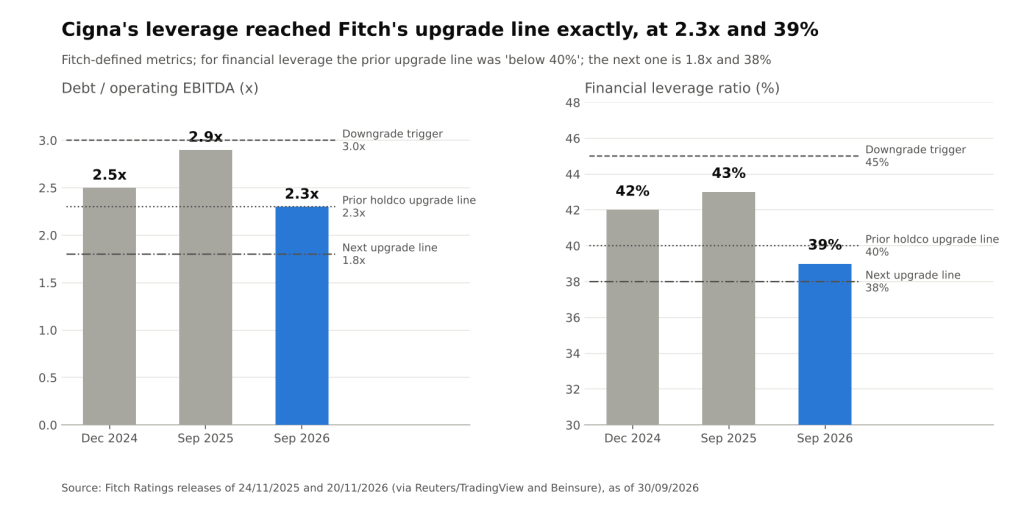
Cigna’s Fitch-defined leverage against the agency’s rating sensitivities (Fitch Ratings @ 30/09/2026)
What Fitch Did, and Why the Notch Gap Mattered
Cigna is a holding company that owns regulated insurers plus Evernorth, its pharmacy benefit and health services arm. Fitch rates the operating insurers on their claims-paying strength (IFS) and then notches down to the holdco, whose creditors sit behind policyholders and depend on dividends and unregulated cash flow. Under Fitch’s insurance criteria, elevated holdco leverage widens that gap beyond the standard differential.
That is what had held Cigna at BBB+. With the operating companies at A+, the holdco sat three notches lower. Fitch now judges that leverage no longer warrants the extra notch, so the gap narrows to two notches (A+ to A-). Nothing changed at the insurers; the upgrade is entirely a holdco leverage story.
Two structural points support the senior unsecured rating sitting level with the IDR rather than below it:
- Evernorth’s cash flow. Fitch credits the sizable, non-regulated cash flows from Evernorth with supporting an average default recovery assumption at the holdco, rather than below average. That is why the senior debt is aligned with the A- IDR.
- Lower government-program exposure. Cigna has no direct Medicaid underwriting, and it sold its Medicare Advantage business (about 3% of medical enrollment) in the first quarter of 2025.
The Metrics Against the Thresholds
The path to 2.3x was not a straight line. At 30 September 2025, debt-to-EBITDA was 2.9x and FLR about 43%, inflated by roughly $4.5bn of senior notes issued that September ahead of maturities; adjusted for maturities through March 2026, Fitch put the figures at 2.6x and about 41%. By September 2026, both measures had come down to the trigger.
| Metric (Fitch-defined) | Sep 2026 | Prior holdco upgrade line | Next upgrade line | Downgrade line |
|---|---|---|---|---|
| Debt / operating EBITDA | 2.3x | ≤2.3x | ≤1.8x | >3.0x |
| Financial leverage ratio | ~39% | <40% | ≤38% | >45% |
| GAAP return on capital | ~8.2% (3-yr avg to 2025) | n/a | ≥9% | <7.5% |
| NAIC RBC ratio | ~230% (YE2025) | n/a | >275% | <235% |
Reading the table from the creditor’s side:
- Leverage headroom is comfortable on the downside. Debt-to-EBITDA sits 0.7x below the 3.0x downgrade line, and FLR is about 6 points below 45%. Both conditions are needed together for that leverage trigger, which adds cushion.
- The next upgrade is far on EBITDA but close on financial leverage. Reaching 1.8x would take another 0.5x of deleveraging, while FLR is only about 1 point away from 38%.
- Capital is the soft spot. Fitch estimates the combined risk-based capital (RBC) ratio at about 230% at year-end 2025, down from 259% a year earlier and below the 235% negative sensitivity. The sensitivity refers to a sustained shortfall, and Fitch expects capitalization to strengthen moderately during 2026, but it is the one metric currently on the wrong side of a line.
- Margins have compressed. Fitch’s operating EBITDA margin averaged about 6% over the three years to 2023, then fell to an estimated 5.2% in 2024 and 4.7% in 2025, driven by stop-loss medical costs and lower-margin pharmacy benefit contracts. As Evernorth has grown, Fitch has shifted its profitability focus to return on capital, which at about 8.2% sits between the 7.5% downgrade and 9% upgrade lines.
Split Ratings Converge
The upgrade also changes Cigna’s position across agencies. Before 20 November, Fitch and Moody’s both sat at the BBB+ level, one notch below S&P’s A-; Fitch now matches S&P.
| Agency | Senior unsecured / ICR | Outlook | Latest action |
|---|---|---|---|
| Fitch Ratings | A- (from BBB+) | Stable | Upgrade, 20/11/2026 |
| S&P Global Ratings | A- | Not stated on IR page | Listed on Cigna IR page as of 24/11/2026 |
| Moody’s | Baa1 | Stable | Affirmed, 24/10/2025 |
| AM Best (holdco ICR) | bbb+ | Stable | Affirmed, 04/03/2026 |
Moody’s Baa1 is equivalent to BBB+, so the issuer is now split A-/A-/Baa1. When Moody’s affirmed in October 2025, it described Cigna’s leverage as relatively high for the rating category, with Moody’s-adjusted debt-to-EBITDA at 2.5x as of June 2025. Moody’s has not acted since, and its adjustments differ from Fitch’s, so the two leverage figures are not directly comparable.
What a Rating Letter Is Worth in Spread
Primary-source pricing for individual Cigna bonds is not available here, so the cleanest reference is the index. The ICE BofA US corporate indices show what the market currently charges, on average, for moving from the BBB bucket to the single-A bucket.
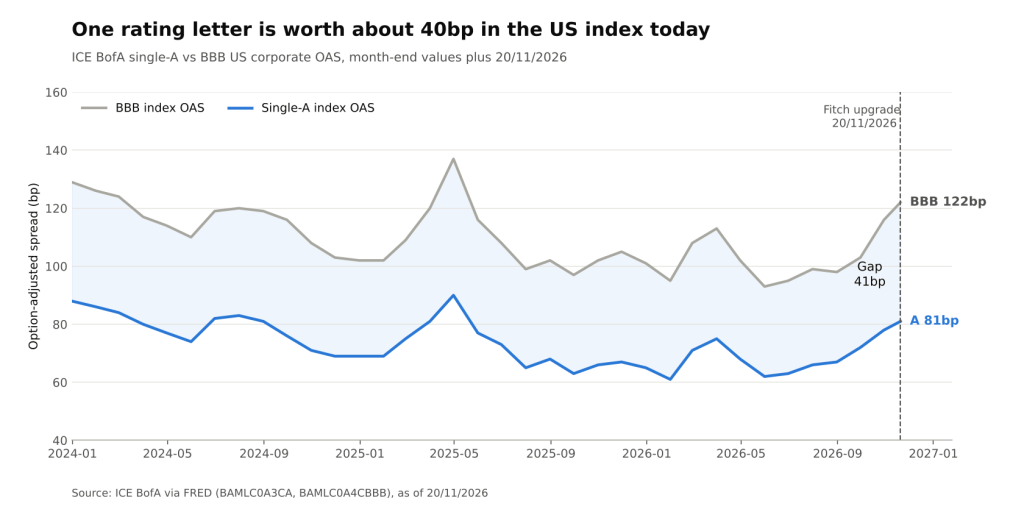
ICE BofA single-A vs BBB US corporate option-adjusted spread, month-end values plus latest (ICE BofA via FRED @ 20/11/2026)
As of 20 November 2026, the single-A index option-adjusted spread (OAS) stood at 81bp and the BBB index at 122bp, a gap of 41bp. A year earlier, on 24 November 2025, the figures were 69bp and 108bp, a gap of 39bp. On month-end readings since December 2023, the gap has ranged from 31bp to 47bp.
Two caveats keep this from being a direct read-through:
- Index averages, not issuer pricing. A Fitch-only upgrade to A- with a Baa1 still outstanding leaves Cigna near the boundary of the two buckets. Index rules that use a middle or average rating would weigh all three agencies, so the bonds need not migrate fully into single-A benchmarks.
- Timing. The upgrade arrived as both buckets were widening. Since 30 September 2026, single-A OAS has risen 9bp and BBB OAS 19bp, so the letter gap has widened by 10bp. That makes the A-versus-BBB distinction more valuable in spread terms than it was in the spring, when the gap touched its 31bp low.
Conclusion
Fitch’s upgrade of Cigna to A- is a clean example of a published sensitivity being met and acted upon: 2.3x debt-to-EBITDA and an FLR just under 40% removed the extra notch between the insurers and the holdco. Downside leverage headroom is ample, while the rating rests on Evernorth’s unregulated cash flow and on capital ratios recovering.
The items to watch are the year-end 2026 RBC ratio against the 235% line, return on capital against the 7.5% to 9% band amid pharmacy benefit margin pressure, and whether Moody’s narrows the split from Baa1. In spread terms, a full move into the single-A bucket is currently worth about 41bp at the index level.
Sources: Beinsure, reporting Fitch Ratings’ 20/11/2026 release; Fitch Affirms Cigna’s Debt Ratings at ‘BBB+’ (24/11/2025); The Cigna Group, Financial Strength & Credit Ratings; Investing.com on Moody’s Baa1 affirmation (24/10/2025); AM Best affirmation (04/03/2026); ICE BofA single-A US Corporate OAS (FRED); ICE BofA BBB US Corporate OAS (FRED).
Daniel Panizo, CFA, FMVA



Leave a Reply